
A Black Trauma Podcast Conversation with Rev. Dr. Philippe SHOCK Matthews
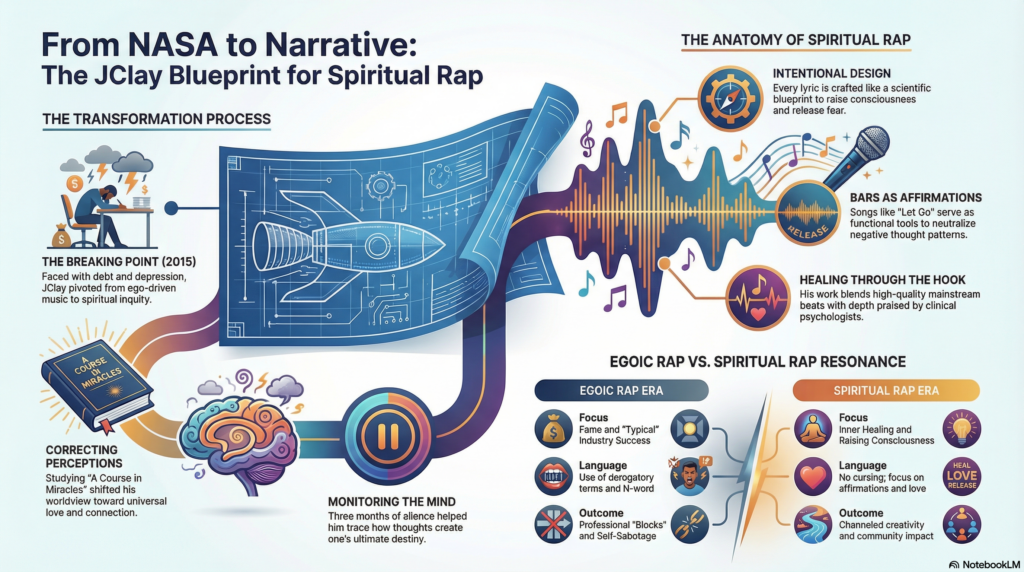
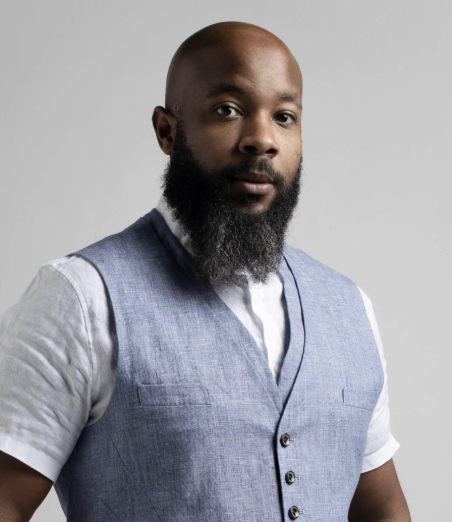
When Jelani Clay—known in the spiritual hip hop world as JClay—opens his mouth to rap, something remarkable happens. His lyrics carry what one psychologist calls “the precision of a scientist and the heart of a healer,” a description that becomes even more profound when you learn of his background as a NASA engineer-turned-spiritual artist. In a recent episode of the Black Trauma Podcast, Rev. Dr. Philippe SHOCK Matthews sat down with this unique voice in conscious music to explore how trauma, spirituality, and hip hop intersect in the journey toward healing and higher consciousness.
The conversation began where all transformative stories must—at the beginning, with what Rev. Dr. Matthews calls a “Sankofa moment,” looking back to move forward. JClay’s origin story is one familiar to many aspiring artists: a young rapper with talent, ambition, and dreams of making it in the music industry. But his path would take an unexpected turn, one guided not by industry gatekeepers but by something he could only describe as divine intervention.
“I used to be a regular rapper,” JClay explained, his voice carrying the weight of hard-won wisdom. “I call it your typical egoic rapper, wanting to be a rap star, making it into the business.” But alongside his musical ambitions ran a deeper current—a spiritual seeker who studied the Bible and wrestled with profound questions about the nature of good and evil, searching for answers that transcended surface-level understanding.
What makes JClay’s story particularly compelling is the series of inexplicable obstacles that arose whenever he got close to achieving his conventional rap dreams. Decision-makers who promised to put him on the radio would suddenly get fired or, in one tragic case, pass away. These weren’t mere setbacks; they were pattern interruptions that forced him to ask deeper questions. “What are you trying to tell me?” he recalled wondering, speaking to the universe, or to God, or to whatever force seemed to be redirecting his path. “I know that the talent is there, people love it, and I know we’re good, but it’s like something isn’t clicking.”
This is where Rev. Dr. Matthews interjected with one of the foundational principles of his work in trauma healing and spiritual consciousness: “Nothing is wrong with black people. Something happened to black people.” It’s a framework that shifts blame from the individual to the systems and circumstances that create obstacles, a perspective that JClay had been unconsciously moving toward as he internalized his failures and used them as catalysts for deeper self-examination.
The turning point came through a book that seemed almost impossibly titled: “Jesus, My Autobiography.” JClay admitted his initial skepticism—how could such a book exist? But something in the excerpt about Jesus’s enlightenment resonated with his own understanding of biblical consciousness, which differed from how society, or even many Black communities, portrayed the figure. Despite his reservations about channeling, which he had been taught to view as evil or demonic, JClay dove in. This led him to “A Course in Miracles,” the transformative spiritual text that has awakened countless seekers to new dimensions of consciousness.
Rev. Dr. Matthews noted his own deep connection to the Course, mentioning his work with Marianne Williamson, who popularized the text and even endorsed his second book back in 2002. “Once they go through A Course in Miracles, everything shifts,” he observed, a statement that JClay confirmed with profound personal testimony. The Course didn’t just change his spiritual understanding; it revolutionized his relationship with music itself.
JClay revealed that he had unreleased material—what he considered some of his greatest work as a conventional rapper—that he could never release after his spiritual transformation. “It just sold more seeds of distrust or just things that just aren’t rooted in love,” he explained. This wasn’t about censorship or limitation; it was about alignment. His consciousness had shifted to a frequency where music that didn’t serve love, healing, and elevation simply no longer resonated with his purpose.
The conversation then moved into the complex landscape of hip hop, rap, and trap music. Rev. Dr. Matthews, who had previously interviewed Lord Jamar about the different levels and categories within hip hop culture, pressed JClay on whether he had participated in the darker aspects of the genre. JClay clarified that while he never claimed to be a gangster rapper, his earlier work definitely fed the ego, focusing on materialism, women, and status—the typical fare of mainstream rap that often masks deeper trauma and disconnection.
“Everything that I’ve done in music, the intent was to be a millionaire or build a legacy where my kids have something to inherit,” JClay admitted. But A Course in Miracles revealed to him that this wasn’t a wrong intent—it was simply misdirected. The real inheritance wasn’t money or fame, but the knowledge of connection to the source, to the divine, to what some might call First-Frequency consciousness. This realization didn’t diminish his ambition; it elevated it to serve a higher purpose.
The transformation manifested in JClay’s artistic process itself. He described being in the studio, feeling a song emerge through him rather than from him. “It’s like taking dictation,” he explained, describing how complete songs would come through in bursts of inspiration. This wasn’t automatic writing in the traditional sense but something deeper—a channeling of divine creativity that produced music with healing properties. Psychologists have praised his work, recognizing its therapeutic power in the frequencies and messages he conveys.
One of the most striking elements of JClay’s music is its intentionality. Every lyric is designed to raise consciousness, release fear, and bring listeners to peace. His song “Erie Lake,” named after Lake Erie, where he’s from in the Midwest, exemplifies this approach. Even in what he considers his most “egoic” track, the celebration of self is crafted so that anyone who sings or raps along would be elevated by the experience. This is music as medicine, sound as healing frequency.
The song “Right Now” addresses relationships from both male and female perspectives, highlighting the patterns and past traumas that people bring into their connections. JClay’s approach was to point out the negative patterns he recognized in himself, demonstrating the vulnerability and self-awareness that characterize authentic healing work. The message is clear: focusing on the present moment—the eternal now—rather than dwelling in past hurts or future anxieties can solve most relational problems.
Perhaps most significant is “Shine Blind,” the first song JClay completed after considering making music in the spiritual realm. The title and concept emerged from a teaching in A Course in Miracles: “Teaching and learning are one.” To teach something, you must learn it well enough to convey it; to learn something deeply, you must know it well enough to teach it. JClay realized that if he wanted to master this spiritual material quickly, he needed to teach it—and his medium was music.
“Can I teach this through music?” he asked himself. The result was what he describes as “the most positive, happy-go-lucky song ever,” yet he loved it with an inexplicable depth. When he performed it for the first time, the audience’s reaction confirmed he was on the right path. This wasn’t just rap; it was transmission, a way of encoding spiritual frequency into rhythm and rhyme that could bypass the analytical mind and touch the soul directly.
Rev. Dr. Matthews shared his own connection to this work, revealing how JClay’s music found him through what he describes as ancestral guidance—what he calls “Amma,” the first utterance of the divine. Working with young men in Sacramento who were into hip hop, Matthews had been searching for something positive to share with them. Then, seemingly out of nowhere, he received an email from JClay’s assistant asking if he’d be interested in having the artist on the podcast.
“I was skeptical,” Matthews admitted with characteristic honesty. As someone he describes as a “militant brother” who provides deep historical and spiritual knowledge to other doctors and PhDs, he approached the music cautiously. “If I hear one Jesus freak pain in here, that’s it,” he thought. But what he found instead was music that didn’t proselytize but enlightened, that didn’t push religion but promoted love. “This is something that is not going to proselytize us into becoming Jesus freaks,” he realized. “It’s going to enlighten us to be love freaks.”
This distinction is crucial in understanding JClay’s work within the context of Black trauma and healing. His music doesn’t impose a religious framework but invites listeners into an experience of love, connection, and consciousness that transcends denominational boundaries. In February, traditionally celebrated as Black History Month, Matthews declared every day “JClay Day,” recognizing that Black history and Black healing are 365-day commitments, not confined to a single month.
Looking to the future, JClay is working on a new album titled “Anthems and Affirmations,” continuing his mission to create music that heals and elevates. He’s also co-founded an organization called The Will with Betty God, a woman whose transformation from an atheist and former prostitute to a spiritual leader mirrors JClay’s own journey from a conventional rapper to a conscious artist. The Will provides daily Zoom meetings where spiritual people from diverse backgrounds—including those with near-death experiences and people in recovery—can connect and support one another.
JClay is also developing a YouTube series with 12 episodes exploring spirituality through nature, asking questions such as: What can we learn from the sun? If the sun had a voice, what would it say to humanity? This creative approach to spiritual teaching reflects his ability to find divine messages in unexpected places, to hear the voice of consciousness speaking through all of creation.
Beyond music and media, JClay offers coaching services that focus on identifying and healing the root patterns that create ongoing problems in people’s lives. “It’s never really that problem,” he explains. “It’s kind of the cause that led to that effect or keeps leading to that effect.” His approach helps people recognize these patterns and, crucially, become okay with the parts of themselves they’ve been taught to hide or judge. This acceptance work is foundational to healing trauma and integrating the fragmented aspects of consciousness.
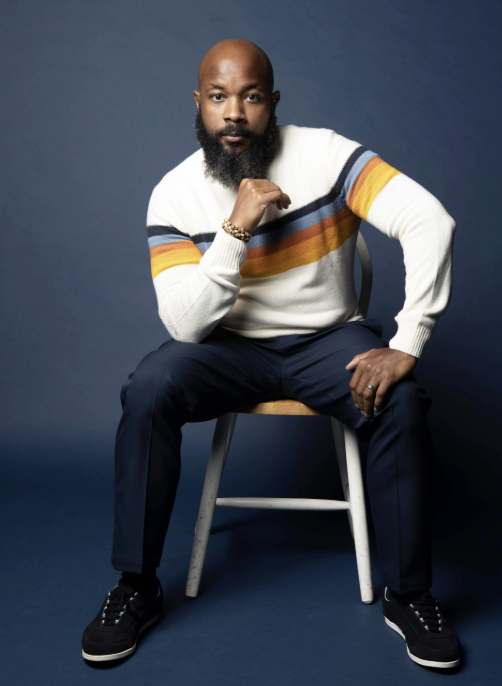
As the conversation concluded, Rev. Dr. Matthews acknowledged JClay as a kindred spirit in the work of healing Black trauma through elevated consciousness. JClay’s journey from NASA engineer to spiritual rapper embodies the intersection of science and spirit, logic and love, trauma and transformation. His music serves as a bridge for those seeking to move from what Matthews calls the Second and Third Frequencies—consciousness shaped by trauma and domestication—toward the First Frequency of divine origin and authentic self.
In a world where Black trauma manifests in countless ways—through systemic oppression, historical injury, and psychological fragmentation—JClay’s work offers a pathway toward what Matthews terms Radical Self Evolution. His songs are more than entertainment; they are tools for consciousness transformation, frequencies that can help listeners remember who they were before the trauma, before the lies, before the separation from source.
For anyone seeking to break free from the cycles of trauma and step into higher consciousness, JClay’s music provides both inspiration and instruction. His website, jclay.org, and his social media presence (@jclay1st) offer access to this healing work. Whether through his music, his coaching, or his community-building with The Will organization, JClay embodies the principle that nothing is wrong with Black people—something happened to Black people, and now healing is not just possible but actively unfolding through conscious artists willing to channel love, truth, and transformation.
As Rev. Dr. Matthews would say, it’s time to break Black trauma. And as JClay demonstrates through every lyric, every beat, and every conscious breath, the path to healing runs through love, presence, and the courage to let divine frequency flow through us into a world desperately in need of its medicine.
LINKS:
JCLAY’S WEBSITE LINK:
JCLAY’S INSTAGRAM LINK:
https://www.instagram.com/jclay1st
JCLAY’S FACEBOOK LINK:
https://www.facebook.com/JClay1st
JCLAY’S YOUTUBE LINK:
https://www.youtube.com/jclay1st
JCLAY’S X LINK:
JCLAY’S TIKTIOK LINK:
THE WHEEL LINK:
JCLAY’S FIRST ALBUM (IAMNOBODY, IAMSOMEONE) LINK:
https://jclay.org/iamnobodyiamsomeone
JCLAY’S SECOND ALBUM (IT JUST FEELS GOOD) LINK: