
By: Rev. Dr. Phlippe SHOCK Matthews
Series Introduction
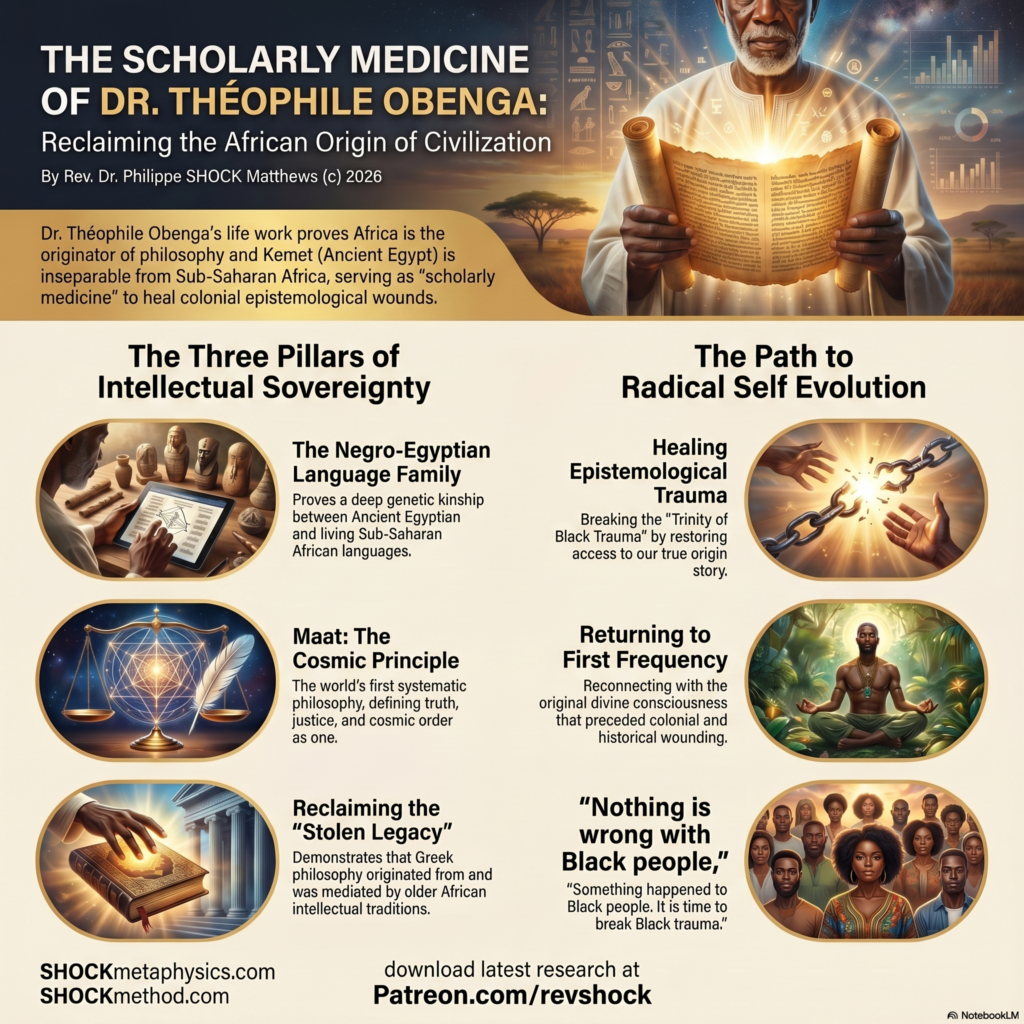
There is a particular kind of intellectual courage required to stand in the corridors of Western academic power and say, plainly and without apology, that Africa is the originator of philosophy, that Egyptian hieroglyphics encode the oldest systematic pursuit of wisdom in the human record, and that the language spoken on the banks of the Nile shares its genetic skeleton with the languages still alive today across sub-Saharan Africa. That is precisely the courage that has defined the decades-long scholarly mission of Dr. Théophile Obenga.
Born in Brazzaville in the Republic of the Congo in 1936, Obenga came of age in the crucible of African colonization — a historical moment when African people were told by European institutions that they had no history worth studying, no philosophy worth teaching, and no civilization worth reclaiming. His response to that assault was not rage alone. It was scholarship. Deep, methodical, linguistically rigorous, historically grounded scholarship that took the very tools Western academia had developed — comparative linguistics, Egyptology, philosophical hermeneutics — and turned them back toward African truth.
This four-part series is an exploration of who Théophile Obenga is, what he built, why it matters to those of us committed to the liberation and healing of African-descended peoples, and how his work intersects with the frameworks I have developed through the SHOCK Method and the study of Africana phenomenology. For those of us who understand that Black trauma is not simply a psychological wound but a spiritual and epistemological one — that colonialism didn’t just take our land and labor but stole our sense of who we are in history and cosmos — Obenga’s scholarship is not merely academic. It is medicine.
In Part One, we begin with the biographical foundations: the Congo, the French colonial educational system, and the formation of a mind that would eventually collaborate with Cheikh Anta Diop and challenge the Western world’s most entrenched assumptions about African civilization.
Part Two takes us into Obenga’s most technically demanding contribution — his theory of linguistic paleontology and the genetic relationship between ancient Egyptian and the African language family. This is where the science lives, where the proof of African continuity is encoded in grammar, morphology, and phonology across thousands of years.
Part Three moves into the philosophical and spiritual heart of his work: the reclamation of Maat as the cornerstone of African philosophical thought, the repositioning of ancient Egyptian civilization as a Black African intellectual tradition, and the implications for how we understand the origins of what the Western world calls ‘philosophy.’
Part Four examines Obenga’s institutional legacy — his leadership of the Centre International des Civilisations Bantu, his contributions to UNESCO’s General History of Africa, his tenure at San Francisco State University, and the enduring significance of his work for communities working to heal from colonial rupture. We will also engage honestly with the critiques that have been leveled at his scholarship, because intellectual honesty requires that we hold our heroes accountable even as we honor their contributions.
My deepest invitation to you, as you move through this series, is to read Obenga not as a distant historical figure but as a mirror — a scholar whose life’s work is, at its core, about the same thing I pursue through the SHOCK Method: helping African people remember who they were before the wound. That remembering is not nostalgia. It is resurrection.