
An Op-Ed in Response to “Black Wellness Edit: Why Black People Are Questioning Mental Health Credentials Online” By Rev. Dr. Philippe SHOCK Matthews, Research Scientist in Africana Phenomenology, Metaphysical Minister of Mental Liberation
The conversation that erupted across Black Twitter in response to the credentialing controversy surrounding Dr. Cheyenne Bryant, and subsequently codified in Ebony’s May 2026 “Black Wellness Edit,” is a conversation that our community has needed to have with far greater depth, intellectual rigor, and cultural specificity than the mainstream mental health discourse has yet permitted. The Ebony piece, authored by Tamieka Welsh and citing licensed marriage and family therapist Jordan A. Madison, makes a reasonable and well-intentioned argument: that licensure matters, that credentials signal accountability, and that Black Americans deserve to know the difference between a therapist and a life coach before they put their healing in someone’s hands. On these procedural points, I have no fundamental quarrel. But the conversation must not end there, and in the hands of our community, it cannot afford to. Because the question being asked — do mental health credentials actually matter? — is not merely a question about professional legitimacy. It is a question about whether Western clinical psychology, as an institutional framework, is structurally capable of healing wounds that Western institutional power created in the first place.
That is the conversation Black people are actually having. And that is the conversation that credentials alone cannot close.

The Credential Question Is a Racial Trust Question
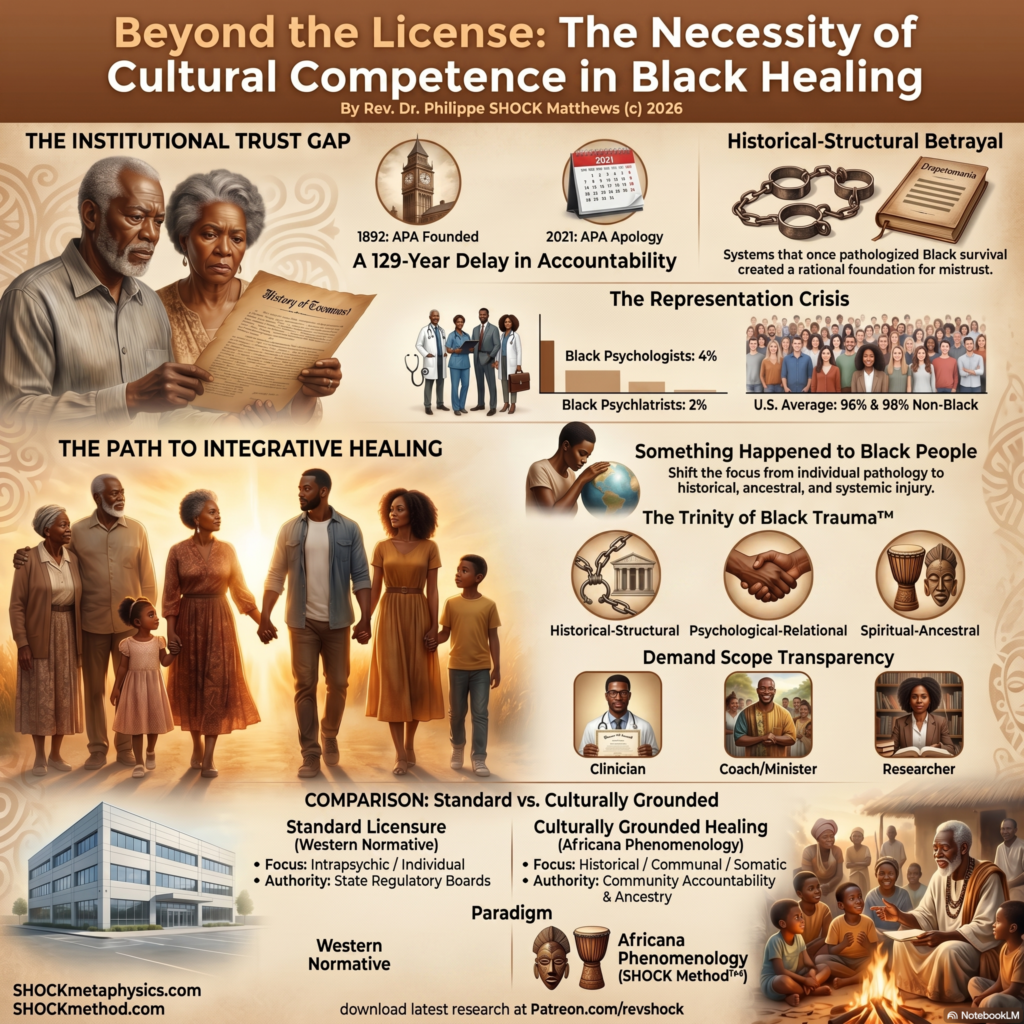
When the Ebony article notes that only 4% of psychologists, 2% of psychiatrists, 22% of social workers, 7% of marriage and family counselors, and 11% of professional counselors in the United States are Black, it presents this statistic as a problem of representation — and it is. But representation is merely the surface layer of a far deeper structural injury. The underrepresentation of Black clinicians in mental health is not a pipeline problem that diversity recruitment can solve in a generation. It is the downstream consequence of a centuries-long system designed to categorically exclude Black intellectual authority from every institution of epistemic production in this country — from universities, to licensing boards, to publishing houses, to the very diagnostic frameworks encoded in the DSM itself.
What Black people are expressing when they question credentials online is not anti-intellectualism. It is a historically grounded, trauma-informed skepticism of institutions that have repeatedly weaponized clinical authority against Black people. Samuel Cartwright’s 1851 fabrication of “drapetomania” — the so-called mental illness that caused enslaved Africans to flee captivity — was produced by a credentialed physician operating within the most respected medical epistemology of his era. The forced sterilization programs of the early twentieth century were administered by licensed professionals with institutional authority and published research behind them. The pathologizing of Black protest behavior by J. Edgar Hoover’s FBI-era psychological operatives was conducted in consultation with credentialed mental health professionals. When our people look at a credential and ask, but what does that certificate actually authorize you to do to me? — that is not ignorance. That is ancestral memory operating as a protective neurological function. In the framework I have developed through over three decades of scholarship and practice, that is the nervous system’s response to what I call Historical-Structural trauma, the first pillar of the Trinity of Black Trauma™.
The Clinical Model Was Not Built for Our Wound
The Ebony article correctly distinguishes between licensed therapists, life coaches, and social media influencers. This is a distinction worth making. But what the article does not interrogate — and what our community deserves to hear plainly — is that the standard clinical model of mental health treatment was architecturally designed for a subject who does not include us. The foundational texts of Western psychology, from Freud’s bourgeois Viennese patient-subjects to the normative assumptions encoded in cognitive-behavioral therapy, presuppose a Self that is individuated, decontextualized from racial power, and whose suffering is primarily intrapsychic rather than structurally imposed. None of that maps cleanly onto the phenomenology of Blackness in America.
W.E.B. Du Bois named this dilemma in 1903 with the theory of double consciousness — the sense of always looking at oneself through the eyes of a world that regards Black being as a problem rather than a person (Du Bois, The Souls of Black Folk, 1903). Frantz Fanon deepened the diagnosis in Black Skin, White Masks (1952), arguing that the colonial encounter produces a fundamental psycho-ontological rupture — a disordering not merely of the individual psyche but of Black being’s relationship to the world itself. Lewis Gordon, whose existential phenomenology of Blackness has been foundational to my own academic formation, extends this tradition by articulating how anti-Black racism functions as a form of bad faith institutionalized at the civilizational level — one that cannot be therapeutically resolved at the level of the individual without simultaneously confronting the structures that produce the injury (Gordon, Bad Faith and Antiblack Racism, 1995).
This is what Joy DeGruy’s landmark work on Post-Traumatic Slave Syndrome (2005) brought into the therapeutic conversation: that the wound Black Americans carry is not a clinical aberration but a rational adaptive response to multigenerational exposure to race-based traumatic stress. Bessel van der Kolk’s somatic neuroscience in The Body Keeps the Score (2014) and Rachel Yehuda’s groundbreaking research on epigenetic transmission of trauma confirm what African-centered healers and spiritual counselors have known through lived knowledge for generations — that racialized trauma is encoded in the body, transmitted across generations through the alteration of gene expression, and that no amount of cognitive reframing produces healing at the level where the injury lives.
This is the scientific and philosophical foundation upon which my SHOCK Method™ — Seeking Higher Omnipotent Conscious/Cosmic Knowledge — was developed. The SHOCK Method™ does not position itself in opposition to licensed clinical practice. It positions itself as the framework that clinical practice, when serving Black people, has been largely unable to supply on its own: a culturally embedded, spiritually grounded, Africana-phenomenological approach to healing that begins with the premise that nothing is wrong with Black people — something happened to Black people.
What a License Cannot Certify
Therapist Jordan A. Madison is correct when she observes that licensure entails state board oversight, continuing education, supervised clinical hours, and regulatory accountability. These are real and meaningful forms of professional quality control. But a license certifies competence within a paradigm. It does not certify that the paradigm itself is adequate to the task.
A licensed therapist who has never been trained in the psycho-social dynamics of anti-Black racism, who has no grounding in Africana epistemology, who pathologizes spiritual practice as a symptom of magical thinking rather than recognizing it as a legitimate epistemological tradition, and who applies individualistic Western models to communally structured African-descent psychologies can do real harm to a Black client — harm that is fully licensed, fully insured, and fully billable. This is not a hypothetical. This is a widespread clinical reality.
My concern with the framing of the Ebony article is that in its entirely reasonable effort to protect Black consumers from unqualified charlatans, it may inadvertently reinforce the very paradigmatic authority that has failed Black people at scale. The implicit message — trust credentials, distrust the uncredentialed — does not account for the fact that some of the most profound healing that has occurred within Black communities has been delivered by elders, by ministers, by traditional healers, by community organizers, and yes, by spiritually and metaphysically trained counselors who held no state-issued license but who possessed something that no licensing exam yet measures: a deep, embodied, culturally fluent understanding of what it means to be Black in America and what it takes to heal from what America has done to Black people.
I hold a Doctorate in Metaphysical Science and Philosophy from the University of Metaphysics in Sedona. I have published over forty peer-reviewed scholarly works on Africana phenomenology, Black trauma, AI equity, and neurodevelopmental adaptations. I have served as a trauma-informed spiritual counselor to hundreds of Black men, women, and families in the Sacramento region and beyond. I host the Black Trauma Podcast, maintain a 65,000-subscriber YouTube platform dedicated to consciousness-raising and healing, and have built, through ShockMetaphysics.com and ShockTraumaFreeWebinar.com, a digital ecosystem designed specifically to bring African-centered healing to our people at scale. I am not a licensed clinical therapist. And I am not claiming to be one. What I am is a healing practitioner operating within a tradition of African-centered metaphysical science that predates and in many dimensions surpasses the epistemic frameworks that Western clinical psychology has codified into licensing regimes.
The question our community should be asking is not simply Is this person licensed? but rather: Is this person trained? Is this person accountable? Is this person rooted in our community’s actual suffering? Does this person’s framework begin with the premise of our wholeness or our pathology? And does the healing they offer reach the level — biological, spiritual, ancestral — where our wound actually lives?
Toward a Standard of Cultural Competence and Spiritual Accountability
I want to be clear about what I am not arguing. I am not suggesting that credentials are irrelevant. For clinical diagnosis of psychosis, bipolar disorder, major depressive disorder, or any condition that requires psychiatric medication, a licensed clinician is not merely preferable but necessary. The regulatory apparatus governing clinical licensure exists for legitimate reasons, and Black people deserve fully competent, fully trained practitioners when clinical intervention is needed. Furthermore, the representation crisis identified in the Ebony article is real and must be addressed urgently. We need more Black licensed therapists, more Black psychiatrists, and more Black psychologists — practitioners who bring both clinical training and lived cultural understanding to the therapeutic encounter.
But we must simultaneously insist that the mental health ecosystem serving Black communities be expansive enough to include the full range of our healing traditions: African-centered counseling, metaphysical ministry, spiritual direction, community elder wisdom, ancestral healing practices, somatic bodywork, and the full integration of the spiritual and neurobiological dimensions of trauma recovery. The SHOCK Method™ is designed to operate precisely in this integrative space — bridging the scientific literature on epigenetics, the HPA axis stress response, and neuroplasticity with the Africana cosmological wisdom embedded in Kemetic, Dogon, and Yoruba traditions, in service of a healing modality that honors the full complexity of who Black people are.
The Four Frequencies of Humanity™ — the framework through which I conceptualize consciousness levels from our First-Frequency divine origin, through the trauma-induced distortions of Second-, Third-, and Fourth-Frequency consciousness — provides Black people with a spiritual and phenomenological map of their own interior landscape that no DSM diagnostic category even attempts to chart. Radical Self Evolution™, the destination framework toward which the SHOCK Method™ is oriented, is not a clinical outcome. It is a sovereign reclamation of Black being at the deepest levels of consciousness. That is not something a licensing exam can certify, because it is not something the licensing paradigm has yet learned to imagine.
Conclusion: Expand the Standard, Don’t Just Enforce the Old One
The community debate sparked by this moment is not a crisis. It is an opportunity. Black people questioning credentials online is not a symptom of distrust run amok — it is a community in the process of constructing a more sophisticated and culturally specific standard for healing authority. We should welcome that process rather than rush to close it down with the reassurance that the current credentialing system has it covered. It does not. Not yet. Not fully. Not for us.
The standard we need is one that holds healers accountable not only to state licensing boards but to our community’s lived reality, to our cultural and ancestral epistemologies, to the scientific literature on racialized trauma, and to the spiritual dimensions of African-descent being that Western clinical frameworks have historically dismissed or pathologized. We need rigorous training, transparent credentials, ethical accountability, and deep cultural grounding — and we need the wisdom to understand that these requirements are not always found together in a single licensed practitioner, and that credentialing alone has never been sufficient to make anyone a healer of Black trauma.
Something happened to Black people. Something systemic, something spiritual, something biological, something ancestral. And the healing of that something requires more than what any licensing board in America has yet authorized. It requires us.
Nothing is wrong with Black people — something happened to Black people. IT’S TIME TO BREAK BLACK TRAUMA!
Rev. Dr. Philippe SHOCK Matthews is a Research Scientist in Africana Phenomenology, Metaphysical Minister of Mental Liberation, and host of the Black Trauma Podcast. He is the founder of the SHOCK Method™ and the Four Frequencies of Humanity™ framework, and the author of more than 40 peer-reviewed publications on Black trauma, Africana phenomenology, and AI equity. He can be reached at ShockMetaphysics.com and ShockTraumaFreeWebinar.com.
LATEST RESEARCH:
Licensed but Not Sufficient: Epistemic Violence, Institutional Racism, and the Crisis of Clinical Authority in Black Mental Health Care – https://www.academia.edu/168393986/Licensed_but_Not_Sufficient_Epistemic_Violence_Institutional_Racism_and_the_Crisis_of_Clinical_Authority_in_Black_Mental_Health_Care