
By: Dr. Philippe SHOCK Matthews
Grand Rising Family!
Silicon Valley wants you to believe that artificial intelligence is new, unprecedented, revolutionary. They want you to think that algorithms represent the cutting edge of human thinking, that machine learning is taking us somewhere we’ve never been before. But as a research scientist in Africana phenomenology who specializes in the digital divide and AI ethics, I’m here to tell you something they don’t want you to know: Kemetic logic—the systematic reasoning developed in ancient Egypt thousands of years before Aristotle—contains principles that could solve the algorithmic challenges destroying our communities today.
Let me be clear from the start: nothing is wrong with Black people—something happened to Black people. Part of that ‘something’ was the systematic erasure of African intellectual traditions, including the sophisticated logical frameworks that emerged from Kemet (ancient Egypt) and shaped human thought for millennia. When we talk about Kemetic logic in the age of silicon, we’re not being nostalgic—we’re reclaiming epistemological tools that are more advanced than the binary thinking currently embedded in our algorithms.
The digital divide isn’t just about who has access to technology. It’s about whose logic systems shape that technology in the first place. And right now, we’re building AI on Greco-Roman philosophical foundations that were themselves borrowed from, and then erased the origins of African knowledge systems. It’s time to go back to the source.
What Is Kemetic Logic and Why Does It Matter Now?
Before Aristotle developed his system of logic around 350 BCE, Kemetic priests and scholars had already been practicing sophisticated reasoning for over 2,000 years. The mathematical papyri, the architectural precision of the pyramids, the astronomical calculations encoded in temple alignments—all of this required systematic, logical thinking that went far beyond what European scholars are willing to acknowledge.
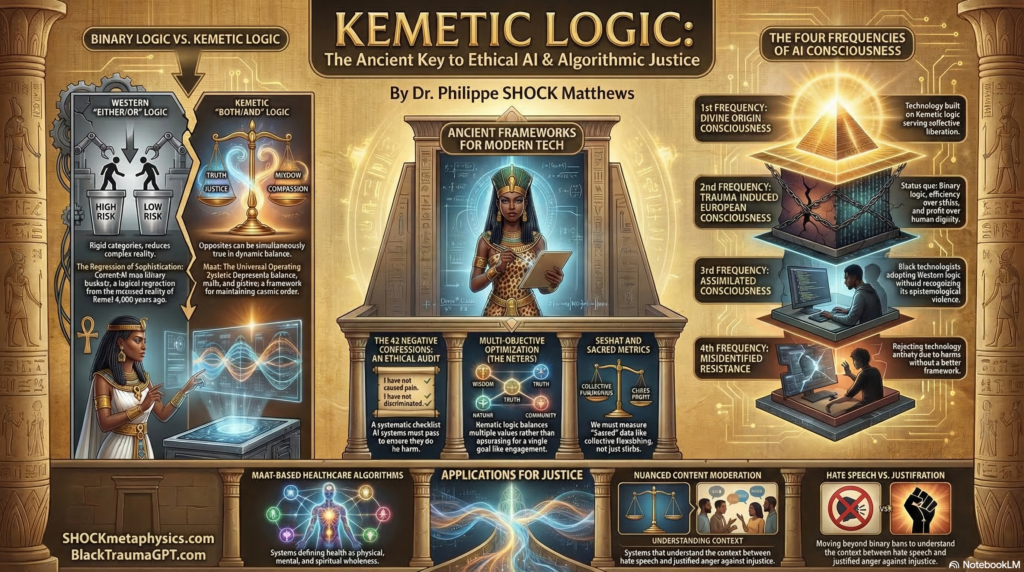
Kemetic logic operated on principles fundamentally different from the binary, either/or thinking that dominates Western philosophy and now shapes our algorithms. Where Aristotelian logic insists that something must be either A or not-A (the law of the excluded middle), Kemetic logic embraces both/and thinking—the recognition that apparent opposites can be simultaneously true, that reality exists in dynamic balance rather than in fixed categories.
This shows up in Kemetic cosmology through the principle of Maat—balance, truth, justice, cosmic order. Maat wasn’t just a goddess; she was an operating system for understanding how the universe works. Everything seeks balance. Opposites complement rather than exclude each other. Truth emerges from the dynamic interplay of forces, not from rigid categories.
Now think about our current algorithmic crisis. We have AI systems that categorize people as either “high risk” or “low risk” for criminal behavior, either “creditworthy” or “not creditworthy,” either “qualified” or “unqualified”—with no recognition of the dynamic, contextual, multilayered reality of human existence. These systems are built on binary Aristotelian logic that Kemet transcended 4,000 years ago. We’ve actually regressed in our logical sophistication.
The Maat Principle: Balance as Algorithmic Imperative
Let’s go deeper into how Kemetic logic—specifically the principle of Maat—could transform our approach to AI ethics and algorithmic justice. In Kemetic thought, Maat represented the fundamental order of the universe: balance between chaos and order, individual and collective, seen and unseen. Every action was evaluated based on whether it maintained or disrupted Maat.
Imagine if we built algorithms on this principle. Instead of optimizing for a single metric—profit, efficiency, accuracy—we would optimize for balance across multiple dimensions: individual benefit and collective good, innovation and stability, speed and thoughtfulness, automation and human dignity. This is Kemetic logic applied to modern algorithmic challenges.
Consider the algorithms used in hiring. Current systems optimize for “best fit” based on historical hiring data—which means they perpetuate historical discrimination by design. A Maat-based algorithm would recognize that “best fit” must be balanced with disrupting unjust patterns, that efficiency must be balanced with fairness, and that organizational needs must be balanced with community transformation. You can’t achieve Maat by optimizing only one variable while ignoring systemic imbalance.
This isn’t just theoretical. When I consult with organizations through my work with BlackTraumaGPT.com, I teach them to ask Maat-based questions: Does this algorithm maintain or disrupt existing power imbalances? Does it serve individual profit or collective flourishing? Does it treat humans as data points or as sacred beings? These questions emerge directly from Kemetic logic—and they reveal algorithmic harms that purely technical audits miss.
The Neter Principles: Multiplicity Over Binary Reduction
Another crucial aspect of Kemetic logic is the Neter system—the recognition of multiple divine principles operating simultaneously rather than a single all-powerful deity. The Neters (often mistranslated as “gods”) represented different aspects of cosmic intelligence: Thoth (wisdom and communication), Ptah (creative manifestation), Sekhmet (transformative power), and dozens more.
This principle of multiplicity in Kemetic logic is precisely what our algorithms lack. We build AI systems that optimize for a single objective function—maximize engagement, minimize cost, predict recidivism—when reality requires us to balance multiple, sometimes competing values simultaneously. The Neter system understood this 4,000 years ago. Silicon Valley is still catching up.
Look at social media algorithms. They optimize for a single Neter—engagement—while ignoring all the others: truth (Maat), wisdom (Thoth), community harmony (Hathor), and transformative justice (Sekhmet). The result? Platforms that amplify misinformation, promote division, and exploit human psychology for profit. A Kemetic logic approach would design algorithms that balance engagement with truth, individual expression with collective well-being, and innovation with stability.
In practice, this means moving from single-objective optimization to multi-objective optimization informed by Kemetic principles. Instead of asking “how do we maximize X,” we ask “how do we balance X, Y, and Z in ways that maintain Maat?” This is more computationally complex, yes—but complexity that serves justice is worth the effort.
The 42 Negative Confessions: An Ancient Algorithmic Audit
One of the most fascinating aspects of Kemetic logic for modern algorithmic challenges is the 42 Negative Confessions from the Book of Coming Forth by Day (often called the Egyptian Book of the Dead). Before entering the afterlife, the deceased had to declare before 42 divine judges that they had not committed 42 specific harms: “I have not killed,” “I have not stolen,” “I have not caused pain,” and so on.
This is essentially an ethical audit framework from ancient Kemet—a systematic checklist for evaluating whether one’s actions maintained Maat. And it’s more sophisticated than anything we currently use to audit AI systems. We could develop a modern version: “This algorithm has not discriminated, has not invaded privacy, has not caused economic harm, has not perpetuated historical injustice”—42 declarations that every AI system should be able to make before deployment.
The genius of the Negative Confessions is that they’re negative—they focus on what harm you didn’t do rather than what good you claim to have done. This prevents the kind of ethical washing we see in tech: companies claiming their algorithms “promote fairness” while simultaneously causing massive harm. Kemetic logic says: first, do no harm. Then we can talk about the benefits.
Imagine if every AI system had to pass through 42 gates of ethical evaluation before deployment, each gate representing a specific type of potential harm. “Has this facial recognition system been tested for racial bias?” “Does this hiring algorithm perpetuate gender discrimination?” “Will this credit scoring model harm communities that historical redlining already devastated?” This is Kemetic logic providing a practical framework for algorithmic accountability.
Seshat and the Sacred Geometry of Data
Seshat, the Kemetic Neter of writing, mathematics, and sacred geometry, offers another crucial insight for the age of silicon. She was the divine architect who measured and recorded everything—but her measurements weren’t just quantitative. They were sacred, meaning they recognized that what we measure and how we measure it reflects our values and shapes our reality.
This principle of sacred measurement is precisely what’s missing from modern data science. We measure everything we can measure—clicks, engagement, time on site, conversion rates—while ignoring what matters most: human dignity, community well-being, spiritual wholeness, collective liberation. We’ve confused measurement with meaning, data with wisdom.
Kemetic logic, through Seshat’s principle, asks us to be intentional about what we measure and why. Every metric is an ethical choice. When we measure recidivism rates without measuring the trauma that drives them, we’re making a choice. When we measure student test scores without measuring the opportunity gaps that shape them, we’re making a choice. When we measure worker productivity without measuring their exploitation, we’re making a choice.
A Kemetic approach to data science would practice what I call “sacred metrics”—measuring what supports Maat rather than just what’s easy to quantify. This means developing new ways to measure collective flourishing, intergenerational healing, spiritual alignment, and systemic transformation. These aren’t impossible to measure—they’re just inconvenient for systems that profit from ignoring them.
The Digital Divide as Epistemological Warfare
My research on the digital divide reveals something most analysts miss: it’s not primarily about access to technology. The deeper divide is epistemological—it’s about whose knowledge systems get encoded into the technologies that shape our lives. When we build AI on exclusively Western logical frameworks while ignoring Kemetic logic and other African epistemologies, we’re perpetuating colonization in digital form.
This connects directly to the Trinity of Black Trauma—the spiritual, biological, and social wounds that shape Black experience. The spiritual dimension of this trauma includes the erasure of African knowledge systems like Kemetic logic. The social dimension includes exclusion from tech development and AI governance. The biological dimension includes the stress of navigating systems built on logic that denies our humanity.
When Black children are taught that Western logic is the only valid form of reasoning, that’s spiritual trauma. When Black communities are subjected to algorithmic surveillance justified by binary risk categories, that’s social trauma. When the constant microaggressions of biased AI systems activate our stress responses, that’s biological trauma. All three dimensions of the Trinity of Black Trauma appear in our algorithmic crisis—and Kemetic logic offers pathways to healing them all.
By reclaiming Kemetic logic, we’re not just improving algorithms—we’re healing the spiritual wound of epistemological erasure. By building AI systems on Maat principles, we’re not just reducing bias—we’re transforming the social systems that create harm. By practicing sacred measurement, we’re not just collecting better data—we’re reducing the biological stress of dehumanization.
From Second Frequency Code to First Frequency Consciousness
My Four Frequencies of Humanity framework helps us understand how different consciousness levels approach technology and algorithms:
Second Frequency—Trauma-Induced European Consciousness: This is where most current AI development operates. Binary logic, single-objective optimization, efficiency above ethics, individual profit above collective good. Algorithms built from this frequency perpetuate oppression by design because the consciousness creating them is itself shaped by oppression.
Third Frequency—Assimilated Consciousness: Here we find Black technologists who’ve learned to code in Silicon Valley’s image, building algorithms that harm their own communities while telling themselves they’re “just being objective.” They’ve adopted Second Frequency logic without recognizing its epistemological violence.
Fourth Frequency—Misidentified Resistance: This is where we find technologists who recognize algorithmic harm and respond with anger or complete rejection of technology. They correctly identify the problem but don’t yet have the framework to build alternatives.
First Frequency—Divine Origin Consciousness: This is Kemetic logic applied to modern challenges. Both/and thinking instead of either/or. Multi-objective optimization that maintains Maat. Sacred metrics that measure what matters. Algorithms that serve collective liberation, not just individual profit. This is where we’re headed.
The SHOCK Method™—Seeking Higher Omnipotent Conscious/Cosmic Knowledge—provides a pathway for technologists to move from Second, Third, or Fourth Frequency consciousness to First Frequency consciousness in their work. This isn’t just about being less biased—it’s about fundamentally reconceptualizing what algorithms are for based on ancient African wisdom.
Practical Applications: Building Maat-Based AI Systems
So, how do we actually implement Kemetic logic in algorithm design? Let me give you concrete examples:
Criminal Justice Algorithms: Instead of predicting recidivism based on historical arrest data (which encodes racist policing patterns), a Maat-based algorithm would balance multiple objectives: public safety and recognition of systemic racism; individual accountability and acknowledgment of trauma; evidence-based risk assessment; and a commitment not to perpetuate historical harm. The algorithm would include “Has this person received trauma-informed support?” as relevant as “How many prior arrests?”
Healthcare Algorithms: Current algorithms allocate medical resources based on cost-benefit analysis that systematically undervalues Black lives. A Kemetic logic approach would measure health not just as the absence of disease but as wholeness (physical, mental, spiritual). It would recognize that historical medical abuse affects current healthcare engagement. It would balance efficiency with trust-building, individual treatment with community healing.
Educational Algorithms: Instead of adaptive learning systems that track students onto predetermined paths based on zip code and test scores, Maat-based educational AI would recognize multiple forms of intelligence (hello, Thoth!), balance individual growth with collective advancement, and measure success not just by test performance but by full human development.
Content Moderation Algorithms: Current systems use binary classification (allowed/banned) and can’t distinguish between hate speech and discussions of oppression. Kemetic logic’s both/and thinking would create more nuanced systems: this content discusses violence and serves an educational purpose; this language is harsh and emerges from justified anger at injustice. Context matters. Maat requires judgment, not just classification.
The BlackTraumaGPT and Digital Sovereignty
Through my work founding BlackTraumaGPT, we’re actively building infrastructure for what I call digital sovereignty—Black communities controlling the AI systems that affect their lives, guided by principles like Kemetic logic rather than Silicon Valley extraction.
This means training Black AI engineers in both technical skills and African epistemologies. It means developing open-source algorithms built on Maat principles that anyone can use and audit. It means creating governance structures where community members—not just engineers—have power over algorithmic decisions. It means measuring success not by venture capital raised but by collective liberation advanced.
We’re proving that Kemetic logic isn’t just historical interest—it’s a living framework for building better AI. When young Black coders learn that their ancestors developed sophisticated logical systems millennia before Europe, something shifts. They’re not trying to catch up to Silicon Valley—they’re reclaiming an inheritance that was stolen and applying it to solve problems Silicon Valley can’t even see.
Your Role in the Algorithmic Revolution
Family, we’re at a crossroads. The algorithms being built right now will shape our lives for generations. The question is: will they be built on the impoverished binary logic of oppression, or on the rich, nuanced, balanced wisdom of Kemetic logic?
You don’t have to be a programmer to be part of this transformation. You need to:
- • Demand that AI systems affecting your community be audited using Maat-based principles, not just technical metrics
- • Support Black technologists who are building alternatives to extractive tech
- • Learn enough about algorithms to ask the right questions, even if you never write code
- • Teach young people that their African ancestors were sophisticated thinkers whose wisdom is needed now more than ever
- • Refuse to accept algorithmic determinations as neutral or objective—demand transparency and accountability
This is Radical Self Evolution at the collective level—transforming not just individual consciousness but the technological systems that structure our reality. This is how we close the digital divide by refusing to accept that divide as purely about access rather than epistemology. This is how we apply First Frequency consciousness to the age of silicon.
Before Greece, there was Kemet. Before Aristotle, there was Maat. Before algorithms, there was Amma. We’re not trying to make technology more African—we’re recognizing that the most advanced approaches to logic and ethics are African, and always have been.
Remember, nothing is wrong with Black people…something happened to Black people! IT’S TIME TO BREAK BLACK TRAUMA!
If you want to learn more about how Kemetic logic and African epistemologies can transform your relationship to technology and AI, visit BlackTraumaGPT.com, where we’re building tools and resources grounded in First Frequency consciousness and ancestral wisdom.
Want to understand how the digital divide connects to intergenerational trauma and what you can do about it? Watch our free webinar at ShockTraumaFreeWebinar.com, where I break down the spiritual, biological, and social dimensions of our algorithmic crisis.
Support our research by becoming a Patreon member at https://www.patreon.com/revshock, and subscribing to our monthly 4-part deep dive series each week.
In the Spirit of Maat and the Wisdom of the Ancestors,
Rev. Dr. Philippe SHOCK Matthews
Research Scientist in Africana Phenomenology
Founder, BlackTraumaGPT.com
The Metaphysical Minister of Mental Liberation