
By: Dr. Philippe SHOCK Matthews
Family.
There’s a question that haunts the African diaspora, whispered in therapy sessions and shouted in rage, pondered in midnight silence and debated in academic halls: Who would we be if they had never come? Who would we be if the ships had never sailed, if the chains had never bound, if the whips had never fallen, if our names had never been stolen, if our languages had never been forbidden, if our spirituality had never been demonized? Who would we be without the Maafa—that great catastrophe, that African Holocaust that didn’t just kill bodies but tried to murder consciousness itself?
This isn’t idle speculation or nostalgic fantasy. This is the central phenomenological question of Black existence in the modern world: how do we reconstruct identity beyond the colonial frameworks that were designed to replace our original consciousness with something controllable, exploitable, and ultimately disposable? Because here’s what Africana phenomenology reveals: the identity most Black people carry isn’t authentic self-knowledge—it’s colonial construction masquerading as natural fact. We’ve been taught to understand ourselves through categories invented by our oppressors, to measure our worth by their metrics, to see our reflection in their distorted mirrors.
The Maafa didn’t just physically transport millions of Africans across the Middle Passage. It transported consciousness itself—ripping people from ontological frameworks rooted in Ubuntu, cosmic interconnection, and ancestral continuity, then forcing them into Cartesian individualism, Christian dualism, and capitalist commodification. And that violent transplantation of consciousness has been passed down through generations, encoded in language, embedded in institutions, inscribed in neural pathways, until most of us can’t even imagine what pre-colonial Black consciousness felt like, tasted like, moved like.
But phenomenological reconstruction makes the unimaginable possible. By carefully examining the structures of consciousness itself, by tracing how colonial violence distorted our fundamental ways of being in the world, and by reaching back to African philosophical and spiritual traditions that preserved fragments of what was stolen—we can begin to rebuild identity beyond the Maafa’s shadow. This is the work of liberation at its deepest level: not just changing external conditions but reclaiming the very consciousness that colonialism tried to destroy.
The Maafa as Ontological Catastrophe: More Than Physical Enslavement
To understand why phenomenological reconstruction is necessary, we need to grasp the true scope of the Maafa. Most histories focus on the physical horrors—and they were unspeakable: millions dead during capture, millions more during the Middle Passage, generations brutalized under slavery’s whip. But the Maafa was also an ontological catastrophe, an assault on the very structure of Black being that created wounds in consciousness itself.
Phenomenology, as developed by Edmund Husserl and later by African thinkers such as Lewis Gordon and Paget Henry, examines the structures of lived experience—how consciousness constitutes meaning, how we experience ourselves and the world, and what frameworks organize our reality. When you apply phenomenological analysis to the Maafa, you discover it wasn’t just enslavement of bodies but systematic destruction and replacement of African ontological frameworks.
Consider what was stolen: languages that carried specific ways of understanding time, causality, and relationships. Spiritual practices that connected individuals to ancestors, cosmos, and community in ways that European Christianity couldn’t comprehend. Social structures are organized around extended kinship and collective responsibility rather than nuclear families and individual property. Economic systems are based on reciprocity and communal ownership rather than accumulation and exploitation. Political traditions rooted in consensus and elder wisdom rather than domination and hierarchy.
Each of these wasn’t just a “different way of doing things”—each was a different structure of consciousness, a different phenomenological framework for being human. And the Maafa systematically destroyed them while imposing European frameworks in their place. Enslaved Africans were forbidden to speak their languages, practice their spirituality, maintain their kinship systems, or pass down their philosophical traditions. What they were forced to adopt instead was a consciousness designed to make them accept their own subjugation: Christian theology that promised freedom only in death, individualism that isolated them from collective power, and European languages that literally lacked words for concepts central to African worldviews.
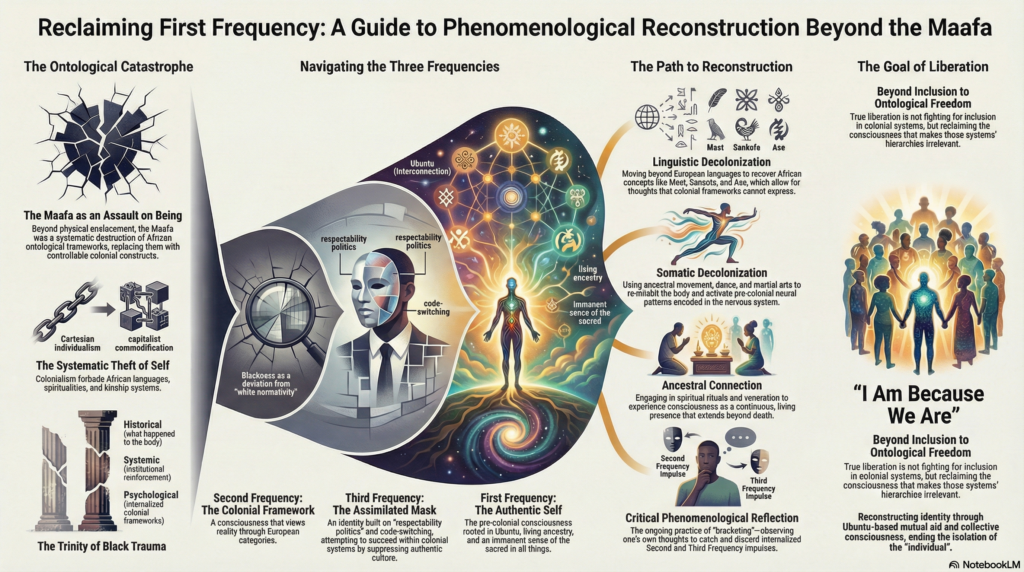
Through the SHOCK Method™—Seeking Higher Omnipotent Conscious/Cosmic Knowledge—we can identify how this ontological violence created what I call the Trinity of Black Trauma operating at the level of consciousness itself. The historical trauma isn’t just about what happened to bodies but what happened to ways of being. The systemic trauma operates through institutions that continuously reinforce colonial consciousness frameworks. The psychological trauma manifests when we internalize these frameworks as natural rather than imposed, when we can’t imagine consciousness existing any other way.
Colonial Identity Construction: The Phenomenology of Invisibility
W.E.B. Du Bois described “double consciousness”—that peculiar sensation of always seeing yourself through the eyes of others, of measuring your soul by the tape of a world that looks on in amused contempt. This is a phenomenological insight: Du Bois identified how colonialism doesn’t just oppress externally but gets internalized into the very structure of self-awareness. You don’t just live in a racist world; you begin to see yourself racially, to experience your own being as a problem.
Frantz Fanon deepened this analysis in “Black Skin, White Masks,” describing how colonialism creates what he called the “epidermalization” of inferiority—where your skin becomes the screen onto which colonial pathology projects itself, and you begin to experience your own embodiment as deficiency. Fanon showed how Black people under colonialism develop a fragmented consciousness: part of you accepts the colonial gaze and its judgments, while another part rebels against it, and yet another part tries to transcend it through assimilation.
This fragmentation is what I describe as Second- and Third-Frequency consciousness. Second Frequency is the colonial framework itself—the consciousness that sees reality through European ontological categories, that treats Blackness as deviation from white normativity, that measures value through capitalist metrics. Third Frequency is the assimilated consciousness that tries to succeed within Second Frequency systems by becoming as “acceptable” as possible—through respectability politics, code-switching, and suppression of authentic cultural expression.
But here’s what phenomenological analysis reveals: both of these are constructed identities, not authentic being. They’re responses to colonial violence, adaptations to hostile environments, and survival strategies in contexts of domination. They’re not who you actually are at the level of fundamental consciousness—they’re masks you learned to wear because showing your face felt too dangerous.
Lewis Gordon’s phenomenological work on anti-Black racism shows how this operates: under white supremacy, Black people face what he calls “ontological collapse,” where their being gets reduced to their appearance, where they exist for others only as body, as threat, as object of fascination or fear, but never as full subject with inner life and authentic consciousness. The colonial identity is precisely this reduction—you learn to experience yourself as object rather than subject, as what you are for others rather than who you are in yourself.
First Frequency: The Consciousness That Existed Before and Beyond
So what does authentic Black consciousness look like, uncontaminated by colonial frameworks? This is where my Four Frequencies model becomes essential. First Frequency represents consciousness as it existed before the Maafa, as it still exists in African philosophical and spiritual traditions that preserved pre-colonial ways of being, and as it can exist again when we engage in phenomenological reconstruction.
First Frequency consciousness is characterized by several key phenomenological structures that differ fundamentally from those of European frameworks. Where Cartesian consciousness posits mind-body dualism, First Frequency experiences embodied consciousness—you don’t have a body, you are bodied consciousness, and there’s no meaningful separation. Where Western individualism sees discrete, isolated selves, First Frequency operates from Ubuntu—”I am because we are,” where individual identity is inseparable from collective identity and ancestral lineage.
Where European metaphysics treats ancestors as dead and gone, First Frequency experiences them as living presences, accessible dimensions of consciousness that continue to participate in the world. Where capitalism sees nature as a resource for extraction, First Frequency experiences nature as living consciousness with which we’re in relationship. Where Christian theology posits a transcendent God separate from creation, African cosmologies understand divinity as immanent—the sacred permeating everything, accessible through ritual, rhythm, and right relationship.
These aren’t just different beliefs about reality—they’re different structures of experiencing reality itself. When you operate from First Frequency, time feels different (cyclical rather than linear), causality works differently (synchronistic and relational rather than mechanistic), and your sense of self is fundamentally different (connected and collective rather than isolated and individual).
Research in cultural psychology and neuroscience confirms these aren’t just ideas but measurable differences in cognition and perception. Studies comparing Western and African subjects show different patterns of attention (holistic versus analytic), different conceptions of self (interdependent versus independent), and different emotional experiences and expressions. These differences aren’t genetic—they’re phenomenological, shaped by the ontological frameworks people are socialized into.
Phenomenological Reconstruction: Practical Pathways Beyond Colonial Identity
So how do we actually reconstruct identity beyond colonial frameworks? How do we access First Frequency consciousness when we’ve been socialized entirely within Second and Third Frequency systems? This requires what phenomenologists call “bracketing”—suspending the frameworks we normally take for granted to examine consciousness itself.
Language Recovery and Linguistic Decolonization: Language isn’t just a tool for expressing thoughts—it shapes what thoughts are possible. European languages embed European ontological assumptions. When you speak only English, you’re thinking within English’s phenomenological framework, which lacks concepts central to African consciousness.
This is why movements to recover African languages, even for diaspora people who don’t speak them fluently, matter phenomenologically. Learning key concepts—Ubuntu, Sankofa, Maat, Ase—isn’t just vocabulary acquisition; it’s accessing different ontological frameworks. When you understand Ubuntu not as a translation but as a lived principle, your consciousness shifts. You can’t fully experience “I am because we are” while thinking only in languages built on “I think, therefore I am.”
Spiritual Practice and Ancestral Connection: African spiritual traditions—whether traditional religions, Afro-Atlantic practices like Vodou and Candomblé, or adapted traditions—offer direct pathways to First Frequency consciousness because they weren’t built on colonial frameworks. When you engage in ancestor veneration, you’re not just honoring the dead; you’re practicing a phenomenology where consciousness continues beyond physical death and remains accessible.
Research on ritual practice shows that it creates altered states of consciousness that are measurably different from ordinary waking awareness. These aren’t pathological or primitive states—they’re sophisticated technologies for accessing dimensions of consciousness that Cartesian rationality can’t reach. When you drum, when you enter trance, when you commune with Orisha or ancestors—you’re experiencing consciousness organized differently than colonial frameworks allow.
Community and Collective Practice: Individualism is fundamental to colonial consciousness—it isolates people from collective power while making them easier to exploit. Reconstruction requires rebuilding collective identity through intentional community practice. This isn’t just gathering with Black people; it’s engaging in specifically African-derived forms of collective being.
When Black churches do call-and-response, that’s not just participatory worship—it’s a phenomenology of collective consciousness where individual and group become temporarily indistinguishable. When African dance brings community into synchronized movement, that’s accessing collective consciousness states. When extended families and chosen families practice Ubuntu-based mutual aid, that’s reconstructing First Frequency ontology in daily life.
Somatic Decolonization: Fanon showed how colonialism gets written into the body, how Black people learn to experience their own embodiment through colonial lenses. Reconstruction requires somatic practices that allow you to re-inhabit your body from First Frequency consciousness rather than experiencing it as Second Frequency defines it.
African movement traditions—dance, martial arts, sacred movement—offer pathways here. When you move in ways ancestral bodies moved, when you practice embodiment that wasn’t shaped by European aesthetic or functional demands, you access pre-colonial phenomenology of the body. Neuroscience shows that movement patterns activate corresponding neural patterns, meaning ancestral movement can literally activate ancestral consciousness encoded in your nervous system.
Critical Phenomenological Reflection: Finally, reconstruction requires ongoing practice of examining your own consciousness to identify where colonial frameworks still operate. This is the hardest work because you’re using consciousness to examine consciousness, using frameworks to question frameworks. But phenomenological training—learning to observe your own experience without immediately interpreting it through familiar categories—creates space for authentic self-knowledge to emerge.
When you notice yourself judging your features against European beauty standards, that’s a sign of colonial consciousness. When you catch yourself measuring success through capitalist metrics, that’s identifying Second Frequency thinking. When you observe the impulse to code-switch or suppress cultural expression, that’s seeing Third Frequency adaptation. Each recognition creates an opportunity to choose differently, to practice First Frequency responses instead.
The Political Stakes: Why Identity Reconstruction Is Liberation Work
Some might argue this focus on consciousness and identity is escapist, that material conditions matter more than phenomenological frameworks. This fundamentally misunderstands how oppression works and how liberation happens. Systems of domination don’t just control through physical force—they colonize consciousness itself, making people internalize frameworks that justify their own subjugation.
When Black people operate from colonial identity frameworks, we unconsciously collaborate with our own oppression. We police each other using white supremacy’s standards. We compete rather than cooperate because individualism has replaced Ubuntu. We devalue African aesthetics, languages, and practices because we’ve internalized European frameworks that position them as inferior. This isn’t a moral failing—it’s the success of the construction of colonial consciousness.
Phenomenological reconstruction undermines this at the root. When you operate from First Frequency consciousness, you can’t accept narratives of Black inferiority because your phenomenological framework doesn’t include racial hierarchy. You can’t be divided by colorism and classism as easily because your sense of identity is grounded in collective consciousness rather than individual distinction. You can’t be convinced to abandon your community for individual advancement because your First Frequency framework doesn’t separate individual from collective flourishing.
This is why movements rooted in reconstructed consciousness—Black Power, Afrocentrism, Pan-Africanism at their best—threaten systems of domination more than movements that accept colonial frameworks while fighting for inclusion within them. The latter can be managed through limited reforms. The former challenges the ontological foundations of white supremacy itself.
Family, the Maafa tried to destroy who we are at the deepest levels of consciousness and being. It succeeded in creating profound confusion about identity, leaving generations of Black people defining themselves through trauma, through opposition to whiteness, through colonial categories that were never designed to capture our fullness. But phenomenological reconstruction offers a pathway beyond this: not back to some imagined pure past, but forward to consciousness that recovers what was stolen while integrating what we’ve learned through survival.
You are not the identity colonialism constructed. You are not defined by trauma, not limited to Second Frequency consciousness, not reducible to the pathologies projected onto Blackness. Underneath all of that lies First Frequency consciousness—your original ontological framework, your ancestral inheritance, your phenomenological birthright. Accessing it requires intentional practice, community support, and willingness to suspend everything you’ve been taught about who you are to discover who you actually are.
Remember: nothing is wrong with Black people—something happened to Black people, and it happened to our consciousness first. But phenomenological reconstruction allows us to reclaim the consciousness that existed before the catastrophe and build identity beyond colonial frameworks. It’s time to break Black trauma by reconstructing identity itself, moving beyond the Maafa’s shadow into First Frequency light.
Go to BlackTraumaGPT.com to access resources specifically designed for phenomenological reconstruction and identity decolonization. We offer frameworks, practices, and community support for the journey beyond colonial consciousness into the being of First Frequency. Schedule a discovery call with Rev. Dr. Philippe SHOCK Matthews to explore how phenomenological reconstruction can transform your understanding of self and enable authentic liberation.
Or watch our free webinar at ShockTraumaFreeWebinar.com to learn how the SHOCK Method™ integrates Africana phenomenology with practical reconstruction strategies, offering pathways to reclaim consciousness beyond the Maafa and build identity rooted in who you actually are.
The Maafa tried to destroy us. It failed. We’re still here, and the consciousness it tried to eliminate is still accessible. It’s time to reclaim it.