
Powered By BlackTraumaGPT.com
Researched and Curated By Rev. Dr. Philippe SHOCK Matthews – https://solo.to/revshock | https://linktr.ee/revshock (Black Trauma and Mental Health Specialist | Prompt Eng | GPT Dev | Research Scientist | Africana Phenomenologist | Black Mental Health Podcast Host | FREE Webin
Host: Rev. Dr. Philippe “Shock” Matthews
Featured Expert: Dr. Obadele Kambon (Abibitumi.com)
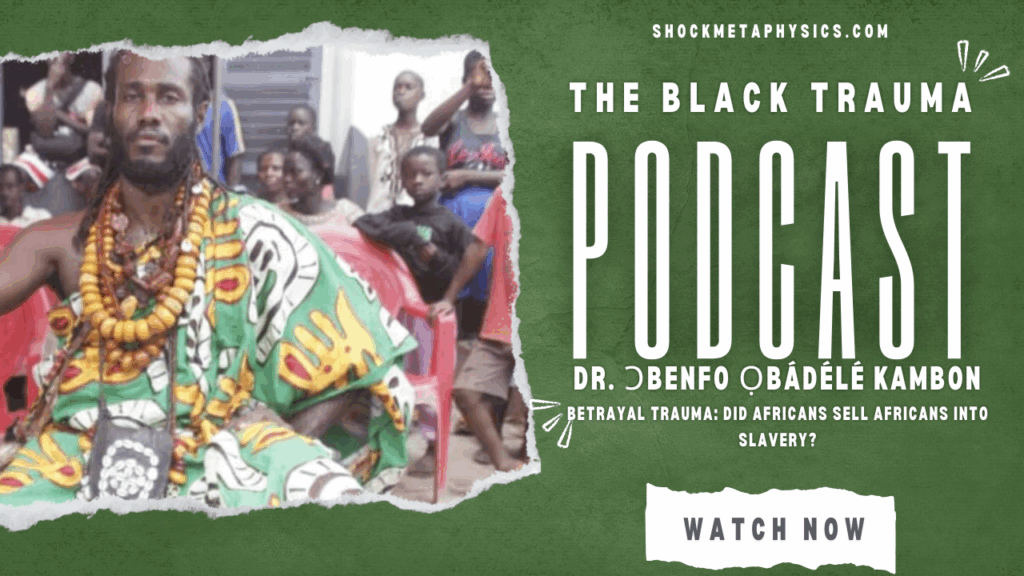
In a powerful episode of the Black Trauma Podcast, Rev. Dr. Philippe “Shock” Matthews sat down with renowned scholar Dr. Obadele Kambon to tackle one of the most persistent and damaging myths in Black history: the notion that “Africans sold Africans into slavery.” With his doctorate in linguistics and deep expertise in tracing oral histories, Dr. Obadele Kambon brought primary sources and scholarly evidence to dismantle this harmful narrative that has been used to justify centuries of trauma and misdirect righteous anger.
The Genesis of a Necessary Conversation
The conversation emerged from Dr. Obadele Kambon’s experience with a German media outlet, DW, where he participated in a panel about repatriation to Ghana. After reviewing over 2,000 comments on the video, which garnered nearly half a million views, Dr. Obadele Kambon was struck by the prevalence of the “y’all sold us” narrative appearing in comment after comment. “Just about every other comment was ‘y’all sold us,'” he explained to Rev. Matthews. “People were telling a sister from Kenya ‘y’all sold us’ – they don’t even have their geography right.”
What troubled Dr. Obadele Kambon most was the realization that among those thousands of commenters, virtually none had read any primary sources about the origins of the transatlantic slave trade. Their historical knowledge was based entirely on popular narratives and social media discourse, rather than foundational texts documenting how these atrocities began.
Understanding Anachronism: The Foundation of the Myth
Central to Dr. Obadele Kambon’s analysis is the concept of anachronism – the placement of persons, events, or customs in times to which they do not belong. He illustrated this with a simple example: “It would be like saying the Republicans killed imaginary white Jesus, or the Democrats collapsed the Roman Empire.” The absurdity becomes clear when we realize there were no Republicans or Democrats during those historical periods.
Similarly, the phrase “Africans sold Africans” represents a fundamental anachronism. During the period of the transatlantic slave trade (1441-1888), there was not a single person on the entire continent who self-identified as “African.” The term “Africa” itself was originally used by Romans to describe only a thin strip of land in what is now Tunisia – the conquered province of Carthage. Maps from 1544 and 1554 show that even a century after transatlantic enslavement began, Europeans still only referred to this small North African region as “Africa.”
The operational identities of the time were local, ethnic, and political, not continental. Dr. Obadele Kambon shared insights from his interactions with people from the continent: “I had a course with a Congo teacher who told us that before he even identifies with Congo, he has to get past five other identities – his village, his clan, his ethnic group, and others – before he even gets to the level of ‘Congolese,’ much less ‘Central African.'”
The Psychological Trauma Behind the Myths
Rev. Matthews and Dr. Obadele Kambon explored the psychological mechanisms perpetuating these harmful narratives. When people experience trauma, they often create fantasies, myths, and alternative versions of reality to cope rather than confronting the whole painful truth. This manifests in several ways:
Dissociation serves as a defense mechanism where people detach from reality to shield themselves from trauma. The “Africans sold Africans” narrative functions as dissociative coping, involving altered perception, identity fragmentation, and the construction of alternative narratives.
Cognitive dissonance occurs when reality contradicts core beliefs. Dr. Obadele Kambon noted encountering people in Ghana who literally stated that “white people can’t do anything wrong, only black people do wrong things,” while surrounded by posters showing a white Jesus defeating a black devil.
Stockholm syndrome explains why some prefer to identify with their captors rather than confront the reality of their oppression. Malcolm X’s analysis of house versus field enslaved people, which Dr. Obadele Kambon included in his presentation, perfectly captures this dynamic – the house enslaved person saying “What you mean separate from this good white man? Where you going to get a better job than you get here?”
Primary Sources Reveal the Truth
Unlike the thousands of YouTube commenters who had never consulted historical documents, Dr. Obadele Kambon presented primary sources that definitively show how transatlantic enslavement actually began. The story starts with Antão Gonçalves in 1441, a young Portuguese captain who was initially sent to collect seal skins and oil. Instead, he had what he considered a brilliant idea.
In the chronicles written by Gomes de Zurara and published in 1460, Gonçalves is quoted as saying: “Oh, how fair a thing it would be if we, who have come to this land for a cargo of such petty merchandise, were to meet with the good luck to bring the first captives before the face of our prince.” This single thought became the genesis of the transatlantic slave trade.
The Portuguese chronicles document systematic raids and kidnappings from the very beginning. In 1444, records show 240 captives taken by force, with the proceeds divided among ship captains and Prince Henry the Navigator himself. The Portuguese text explicitly states that they “took them all by force” when encountering people who “had no means of defending themselves.”
Religious Justification for Systematic Enslavement
Dr. Obadele Kambon revealed how Christianity provided the legal and moral framework for perpetual enslavement through papal bulls that most people have never heard of. On June 18, 1452, Pope Nicholas V issued “Dum Diversas,” authorizing King Afonso V of Portugal “to subjugate the Saracens and pagans and other unbelievers and enemies of Christ” and “to reduce their persons into perpetual slavery.”
This was followed by “Romanus Pontifex” on March 25, 1455, which granted “full and free power through the apostolic authority by this edict to invade, conquer, fight, subjugate Saracens and pagans and other infidels and enemies of Christ, and to leave their persons in perpetual servitude.” The emphasis on “perpetual” meant that not only the captured individuals but their children and children’s children would remain enslaved forever, with no possibility of redemption.
These were not declarations of trade or commerce – they were declarations of war that explicitly authorized the systematic capture, subjugation, and permanent enslavement of non-Christian peoples.
The Gun-Slave Cycle and Divide-and-Conquer
Dr. Obadele Kambon explained that it wasn’t until 1626 that Europeans developed mechanisms to get some African groups to capture others, what historians call the gun-slave cycle. Before this point, for nearly two centuries, all captives were taken directly by European raiders and kidnappers. The involvement of some African groups in capturing others came only after Europeans had established systems of coercion and manipulation, providing weapons to some groups to raid others.
This represents the classic divide-and-conquer strategy that continues today. Dr. Obadele Kambon drew parallels between historical conflicts and contemporary situations in places like the Democratic Republic of Congo, Sierra Leone, and other regions where external powers fuel internal conflicts to extract resources. “It’s cheaper to give this guy a $500 gun and that guy a $500 gun, and then they bring me a million dollars in diamonds,” he observed.
The Contemporary Relevance
The persistence of the “Africans sold Africans” myth serves contemporary interests by deflecting attention from the descendants of the actual perpetrators and instigators of these crimes. As Dr. Obadele Kambon noted, people say they can’t go to Africa because “Africans sold Africans.” Still, they can stay in places where Europeans were “not only selling, but also buying, financing, justifying, insuring” – doing no less than twelve different aspects of the slave trade, including selling.
This selective indignation serves to misdirect Black people’s anger toward each other rather than toward the systems and descendants of those who created and profited from these atrocities. Meanwhile, the owners of social media platforms could easily shut down these harmful narratives, but allow them to proliferate because conflict among Black people serves their interests.
The Path Forward
Rev. Matthews emphasized how this misinformation creates “trauma imprints” where people internalize the belief that they deserve their treatment because “we did it to ourselves.” This moral injury runs deep and continues influencing contemporary relationships between continental Africans and diaspora populations.
Dr. Obadele Kambon’s work demonstrates the critical importance of consulting primary sources rather than relying on popular narratives, social media comments, or Hollywood portrayals. His complete presentation, available at abibitumi.com, contains 147 slides of historical documentation that thoroughly debunks the “Africans sold Africans” myth.
Conclusion: Reclaiming Historical Truth
This conversation between Rev. Dr. Matthews and Dr. Obadele Kambon represents more than an academic exercise – it’s a necessary intervention in the ongoing psychological warfare that keeps Black people divided and misdirected. By understanding the true origins of the transatlantic slave trade through primary sources, we can begin to heal from these imposed traumas and redirect our energy toward the actual sources of our oppression.
The evidence is clear: the transatlantic slave trade began with European raids and kidnappings, was legally authorized by papal bulls, and only later involved some African participation through systems of coercion and manipulation. Every single person taken was stolen, kidnapped, and captured against their will. No one volunteered, and no benevolent trade agreements existed between equal partners.
As Dr. Obadele Kambon concluded, “Until people actually read these primary sources instead of getting their history from memes and movies, they’ll continue to perpetuate myths that serve everyone except Black people.” The truth is available for those willing to seek it out – and that truth can set us free from the psychological shackles of internalized falsehoods.
This interview is part of an ongoing series on the Black Trauma Podcast exploring the historical roots of contemporary psychological injuries. For the complete presentation with all primary sources, visit abibitumi.com/fairytales.
FREE SHOCK RACIAL TRAUMA WEBINAR: http://shocktraumafreewebinar.com

“I just completed a brief session with ChatGPT-Black Trauma. Wow! The responses I got were soooooo helpfu!.” — John Jackson (Patreon Member)
At BlackTraumaGPT.com, we aim to foster healing, understanding, and empowerment within Black communities by providing culturally sensitive education, insights, and mental health resources. We aim to deepen the collective awareness of Black trauma’s historical roots and its contemporary manifestations while guiding individuals and communities toward paths of self-care, resilience, and holistic healing. By leveraging the wisdom of Africana phenomenology and the expertise of Black scholars, we support the transformation of trauma into strength, encouraging collective growth and thriving.
IT’S TIME TO BREAK BLACK TRAUMA! Heal Thyself @ BlackTraumaGPT.com http://blacktraumagpt.com/ ASK THE QUESTION(S)!
———————
Get Social with Doc SHOCK:
PATREON | ABOUT DR. SHOCK | FLY SOLO | ACADEMIC BIO | BLOG | BLACK TRAUMA PODCAST | ENDORSEMENT | THREADS | IG | FB PAGE | PRIVATE GROUP | X | LINKEDIN | TIKTOK | PINTEREST | BLACK TRAUMA GPT | BLACK AI CONSORTIUM | BOOKS BY DOC SHOCK