Powered By BlackTraumaGPT.com
Researched and Curated By Rev. Dr. Philippe SHOCK Matthews – https://solo.to/revshock | https://linktr.ee/revshock (Black Trauma and Mental Health Specialist | Prompt Eng | GPT Dev | Research Scientist | Africana Phenomenologist | Black Mental Health Podcast Host | FREE Webinar)
Rev. Dr. Philippe SHOCK Matthews: Welcome back to the Black Trauma Podcast, where we explore the depths of healing in our community. I’m your host, Reverend Dr. Philippe Shock Matthews, also known as the metaphysical Morpheus, and today I have an absolute powerhouse with me.
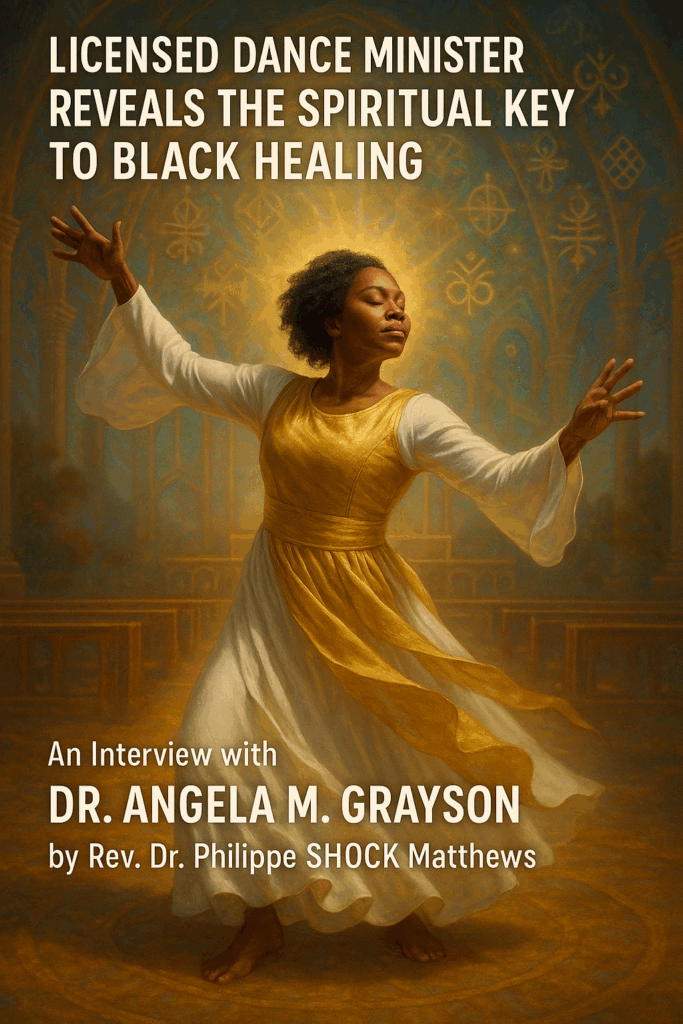
Dr. Angela M. Grayson has over 22,000 published papers on academia.edu—and here I was thinking my 25 papers were impressive! She’s an award-winning therapist, bestselling author, international speaker, educator, and transformational healer. With over 30 years in mental health services, she’s the CEO of Good Fruit Expressive Arts Counseling and Psychotherapy, LLC. But here’s what blew my mind: she’s been a licensed dance minister for over 20 years. I didn’t even know that was a thing!
Dr. Angela M. Grayson: Thank you so much for that beautiful introduction, Dr. Matthews. I’m thrilled to be here and dive into this conversation with you and your audience.
From Computer Science to Sacred Movement
Dr. Matthews: Let’s start with your origin story. What brought you into this field of mental health, and specifically, how did you discover the power of dance in healing?
Dr. Grayson: My journey was definitely not traditional! I actually started as a computer science major. Back when computer science was just emerging as “the thing,” I thought I had it figured out. But after spending an entire night in the computer lab trying to find one misplaced decimal point that threw off our entire program, I knew this wasn’t for me.
At the time, I was young—19, 20—and everyone was coming to me with their problems. Friends, strangers, everyone was telling me their business. I thought, “If I need to be getting paid for people to sit here and tell me their stuff, because I have my own stuff going on!”
Dr. Matthews: So there was something pivotal that pushed you toward psychology?
Dr. Grayson: Yes and no. The trauma experience was more around relationship patterns—choosing the wrong partner repeatedly, same partner with a different face. I traced this back to my father’s patterns; he was married three times. There were broken parts showing up that I needed to explore.
But there was also a profound spiritual experience when I was eight years old. My family was deeply into church—we walked to church, that’s how devoted we were. During a summer camp service in North Carolina, I had this surreal experience where I saw what looked like an angelic being in the corner of the church. The music faded, everything went quiet, and I was having an out-of-body experience, though I didn’t know what to call it at eight years old. That’s when my spiritual gifts awakened, and I thought psychology would help me understand what was happening.
The Birth of a Dance Therapist
Dr. Matthews: How did movement and dance enter the picture?
Dr. Grayson: Dance has always been part of our culture—ceremonial, ritual, healing, social. It’s in the fabric of who we are as a people. I’d always danced, made up choreography, was on step teams, but I didn’t take formal dance classes until college when I needed electives.
The real breakthrough came when I was working as a paraprofessional, assigned to a fourth-grade girl who was completely parentified—cooking and cleaning for her siblings while her parents struggled with addiction. She would come to school angry and exhausted, getting into fights. I started bringing music into our classroom and we’d have dance breaks between assignments. I’d let her nap, we’d take walks—I created our own curriculum.
Dr. Matthews: You were already doing the work without knowing it!
Dr. Grayson: Exactly! By the end of the school year, this little girl was shining. Her grades came up, her behavior improved. Everyone asked, “What did you do?” I said we just made up our own thing and added some dance. That was my major aha moment.
Later, during a summer training program while working for Children and Family Services, I met a dance therapist and thought, “Shut the front door! There’s an actual profession called dance therapy!” I wasn’t discovering something new—there was already a whole field dedicated to this work.
Africanizing European Education
Dr. Matthews: I love how you’ve Africanized your European education. Talk to me about incorporating African-centered approaches into traditional therapy models.
Dr. Grayson: It’s really about the type of music you use, allowing movement to naturally emerge for people, and not labeling everything through a European lens. If somebody is gyrating their hips, we don’t label it as sexualized because we know that’s cultural—it’s not sexual, especially for our young people.
Think about our elders rocking in their chairs, humming while hanging clothes. That’s somatic regulation! We’ve been doing this unconsciously for generations. When we feel stressed, what do we do? Turn on music and start dancing in the house for no reason whatsoever. That’s our natural healing mechanism.
Dr. Matthews: You’re absolutely right. I remember during the Ferguson protests after Mike Brown’s death, I saw young people spontaneously start dancing during protests. At first I thought, “Someone just died, why are you dancing?” Then it clicked—that’s African, that’s us. That’s how we dissipate negative energy and trauma.
Dr. Grayson: Exactly! Even if you go back to enslavement, communication was in dance, in rhythm, in song and poetry. We don’t have to say anything—a look, a nod of the head, and you know what I’m talking about. There’s always a rhythm happening internally, and when it becomes external, it invites community because we’re communal people.
Trauma in the Body: A Somatic Approach
Dr. Matthews: For someone experiencing shallow breathing when stressed, what somatic movement would you recommend?
Dr. Grayson: First, get your feet grounded—really press them into the floor. People think I’m crazy suggesting grounding when the issue is breathing, but if you take a deep breath while ungrounded, you might pass out! Most people only breathe into their chest anyway. When you take in that much air suddenly, your body isn’t used to it and you get lightheaded.
Getting grounded is key to doing deep breathwork safely. Allow your weight to be held by the seat, firmly plant your feet, and press them into the floor before working with the breath.
Dr. Matthews: This connects to epigenetics and ancestral trauma. Should pregnant parents incorporate movement during pregnancy to help ground their children?
Dr. Grayson: Absolutely! It’s about creating a new imprint. The epigenetic markers from the transatlantic slave trade and enslavement are still triggered in us. During pregnancy, the bond that’s forming can create a new imprint with intentional stress management—breathing, dancing, singing, movement, getting into nature, letting the sun bake into the belly.
Both parents participating in reconstructing the nervous system gives the baby a fighting chance to come into this chaotic world with a sense of peace. Pregnancy and ages zero to seven are pivotal developmental periods. What happens in utero and during those early years gets repeated every seven years—that’s when the trauma DJ starts recycling patterns.
Dr. Matthews: I love that—the trauma DJ! Can’t stand that guy.
Beyond CBT: A Humanistic Approach
Dr. Matthews: Talk about the differences between traditional trauma therapy, being trauma-informed, and cognitive behavioral therapy.
Dr. Grayson: First, I need to put this out there—I do not like CBT. Don’t like it at all!
Dr. Matthews: Thank you! I’ve tried to be nice about it, but you’ve given me permission to say it too!
Dr. Grayson: CBT is not the end-all, be-all. As adults, we abandon everything we learned in childhood. Children are curious, carefree, they don’t care who’s watching. But adults walk around so tight and stuffy—it’s part of Western culture. We’re just a head dragging our body around.
The disconnection is insane. We’re so busy being busy that we’re not paying attention to our body’s cues until something major happens—like blood clots or other medical issues. For Black people especially, it’s important to advocate for yourself because medical professionals often don’t listen to our experiences. We have such a high pain tolerance due to those epigenetic markers from being literally dragged from our homeland.
I’m a humanistic psychologist—whole person, whole person treatment. I’m not into labels and diagnoses, though they have their place. I’m not a fan of medication as a first resort, though some people need it. The go-to should be what’s naturally available to help you reach optimal health mentally, spiritually, and relationally.
Neurodivergence and Black Uniqueness
Dr. Matthews: What about the concept of neurodivergence in our community?
Dr. Grayson: These labels are really about making other people comfortable, not helping the person with a unique way of looking at the world. The labels let others say, “Aha, now I know what’s wrong with you.” But nothing’s wrong with you!
During my internship at a psychiatric hospital, I worked in what I call the mental health ER. My favorite population was folks living with schizophrenia because the beauty of how they conceptualize and see the world is incredible. The white staff members always had trouble and were getting attacked, while I was building relationships first. When you address someone’s humanity first, build rapport and mutual respect, then you can discuss what’s going on and how to help them navigate better.
You’re dealing with a person, not a diagnosis, not their medication, not their socioeconomic status. When working with Black people’s trauma, trust and believe we’ve all seen some things. Part of therapy is holding space to honor their narrative and just be there with them.
Sacred Versus Secular: Church Hurt and Healing
Dr. Matthews: Let’s talk about the intersection of faith and therapy. How do you address church hurt while honoring spirituality?
Dr. Grayson: I separate three distinct concepts: faith, spirituality, and religion. Faith is believing in something greater than yourself that guides you. Spirituality is that internal or external source that gives you hope and support. Religion is the institutional structure—the denomination, the building, the set programs.
Once we distinguish between these, we can really talk about church hurt because everybody’s human. If you’re not doing your due diligence to examine what’s true for you versus what was impressed upon you, you’ll struggle. Just because “this is how I grew up” doesn’t mean it’s yours.
We need to analyze what’s actually working for you. Believe in God? Great—but where is God and who is God? That’s the real conversation. The more we examine what we believe about ourselves and what sustains us, whether it’s church five days a week or tapping into that internal indigenous knowing and wisdom we already possess, the better.
The Girlfriend Retreat Experience: Beauty from Trauma
Dr. Matthews: Tell us about the Girlfriend Retreat Experience.
Dr. Grayson: It grew out of my own trauma. In 2016, I married my first love after reuniting 40 years later. We had dated for six years, got married in January, and were planning our whole life together. My dad was sick with cancer, my uncle had passed, and then out of nowhere, my husband passed away in his sleep in September. We were only married nine months.
I was devastated, mad at God—we had beef! But my girlfriends from kindergarten through my doctoral program showed up every single day for three months. Five, six, ten of them at my house making sure I got out of bed, ate, showered. We had dinner, book club, conversations.
What they show on TV—that women are always at each other’s necks—that wasn’t my experience. This was the most loving, supportive experience I’d ever had. I knew if this could happen for me, it could happen for other women.
In 2017, I started hosting four-hour Friday night gatherings that grew into weekend retreats, then international retreats. We’ve been to Dubai twice, Greece, and we’re going to Turkey and Morocco. It all grew from my trauma and my girlfriends having my back.
The Future of Black Healing
Dr. Matthews: What’s next for you?
Dr. Grayson: I’m doing more writing, looking at the epigenetics of dance in the African-American community, especially in relation to trauma. I’m also working on something around the integration of spirituality and indigenous ways of being and knowing into how I show up.
I’m all about integration—there’s never a coincidence in crossing paths with someone. Whether it’s something you need to pay attention to within yourself, something you need to impart to them, or something they need to impart to you, we’re relationally connected for a reason.
Dr. Matthews: How can people get some Angela M. Grayson seasoning in their lives?
Dr. Grayson: I’m Angela M. Grayson on all social media platforms. Check out my website at goodfruitexpressivearts.com—it desperately needs a makeover, but you can still find good information there. Come hang with your girl!
Key Takeaways
Dr. Grayson’s work reminds us that healing has always been in our bodies, our movements, our communities. From the spontaneous dancing during protests to our grandparents’ gentle rocking, we’ve carried the medicine within us. The key is recognizing these natural healing mechanisms and intentionally incorporating them into our wellness practices.
Her journey from computer science to licensed dance minister shows us that our calling often emerges from our own healing journey. By Africanizing traditional therapeutic approaches and honoring the wisdom of our ancestors, we can create more effective, culturally relevant paths to healing.
Most importantly, Dr. Grayson’s story demonstrates that even our deepest traumas can birth something beautiful when we allow our communities to hold us and when we trust the wisdom already within our bodies.
Connect with Dr. Angela M. Grayson on social media @AngelaMGrayson and visit goodfruitexpressivearts.com to learn more about her work in dance movement therapy and the Girlfriend Retreat Experience.
FREE SHOCK RACIAL TRAUMA WEBINAR: http://shocktraumafreewebinar.com
“I just completed a brief session with ChatGPT-Black Trauma. Wow! The responses I got were soooooo helpfu!.” — John Jackson (Patreon Member)
At BlackTraumaGPT.com, we aim to foster healing, understanding, and empowerment within Black communities by providing culturally sensitive education, insights, and mental health resources. We aim to deepen the collective awareness of Black trauma’s historical roots and its contemporary manifestations while guiding individuals and communities toward paths of self-care, resilience, and holistic healing. By leveraging the wisdom of Africana phenomenology and the expertise of Black scholars, we support the transformation of trauma into strength, encouraging collective growth and thriving.
IT’S TIME TO BREAK BLACK TRAUMA! Heal Thyself @ BlackTraumaGPT.com http://blacktraumagpt.com/ ASK THE QUESTION(S)!
———————
Get Social with Doc SHOCK:
PATREON | ABOUT DR. SHOCK | FLY SOLO | ACADEMIC BIO | BLOG | BLACK TRAUMA PODCAST | ENDORSEMENT | THREADS | IG | FB PAGE | PRIVATE GROUP | X | LINKEDIN | TIKTOK | PINTEREST | BLACK TRAUMA GPT | BLACK AI CONSORTIUM | BOOKS BY DOC SHOCK