An Interview Between Rev. Dr. Philippe SHOCK Matthews and Sam Simmons on the Black Trauma Podcast

The Zoom screen flickers to life, and there’s an immediate sense of kinship between the two men who appear. Rev. Dr. Philippe SHOCK Matthews, the metaphysical minister known for his groundbreaking work in Africana phenomenology and Black trauma healing, leans forward with the intensity of someone who knows the conversation ahead will cut deep. On the other side of the screen, calling in from Minneapolis, is Sam Simmons—consultant, author, and the architect behind the Brothers Healing Brothers conference, now in its eighteenth year. His face carries the weight of someone who has just witnessed his city erupt in grief and rage once more.
“We love you, brother,” Dr. Matthews begins, his voice carrying both warmth and urgency. “Because you’re such a juggernaut and icon in Black trauma work, particularly in this country. We were going to talk about Black trauma today, and I suppose we are—because what we saw was traumatizing.”
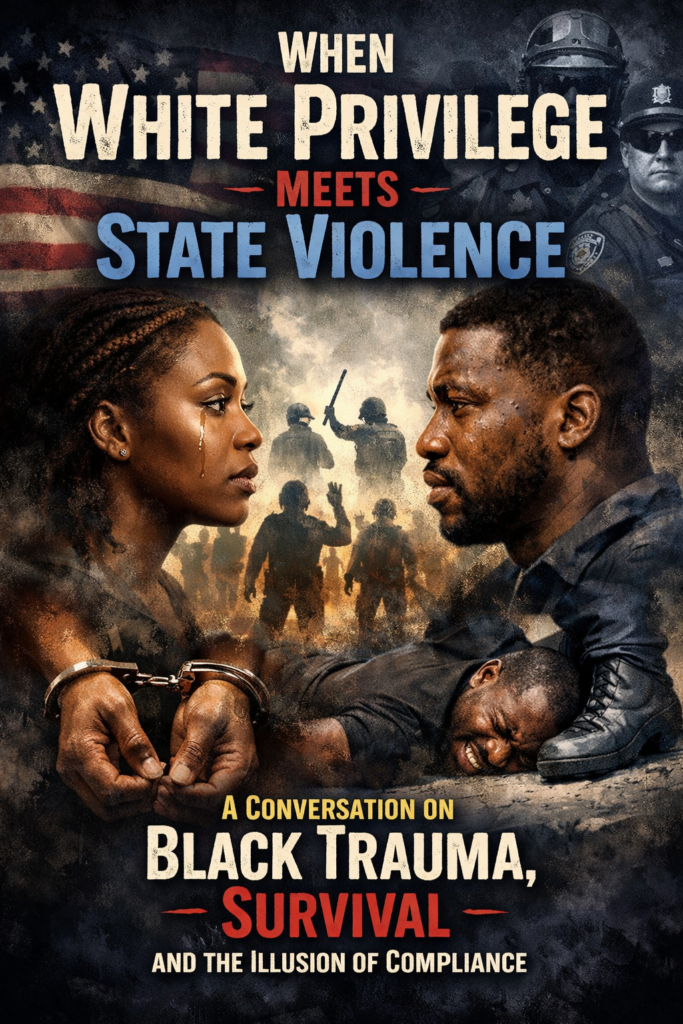
They’re speaking about Renee Nicole Goode, a thirty-seven-year-old white woman executed by an ICE agent on a Minneapolis street in early January 2026, just blocks from where George Floyd was murdered. The incident has sparked national outrage, protests, and a reckoning with questions that Black communities have been asking for generations.
Sam adjusts his camera, his expression thoughtful but unflinching. “I’m not surprised,” he says simply. “I’m not surprised it happened.”
Dr. Matthews nods knowingly. “Dr. John Henrik Clarke said, ‘I’m surprised that you’re surprised.'”
“Right,” Sam continues. “And that’s what gets me—it just doesn’t surprise me. You’ve got folks out here trying to protect people from this chaos. They’re talking immigration, but they’re terrorizing different cities, running up on cars with masks on, telling people to get out. The wild thing is how freely people lie about things and still be in charge. But what really gets me is how many of the general public go along with this stuff.”
The United States of Them and Us
Sam pauses, letting the weight of history settle into the space between them. “Think about our history. It’s been the United States of them and us for a long time. Longer than we’ve been alive. You have folks come into this country and make the natives ‘them’ in a country where they were already here. It’s been the United States of them and us for a very long time.”
“Wait,” Dr. Matthews interjects with mock surprise. “You mean Columbus didn’t discover America? You mean we were already here?”
“Give me a break,” Sam laughs, but the humor is dark. “The other piece that’s sad to me—for some folks, they just laugh about it. When people ask, ‘Sam, what do you think?’ Well, it’s not surprising. This is not new to Black folks. We sit back watching this stuff. The problem now for us in Minnesota is they’re going after Somalis, and anything Black is going to get stopped. That was true before all of this. We’ve had this experience of being stopped for nothing, of being harassed. ICE is acting similar to slave catchers.”
“Very well said,” Dr. Matthews affirms. “That’s where law enforcement was born, if you will.”
“Right. Slave catchers were on a mission to terrorize folks and put them in their place,” Sam explains. “Living in Minnesota is interesting because we’re considered liberal—it kind of is a liberal state—but it’s like not caring until it happens to me. When you don’t have compassion for other people, that’s a problem. Because eventually, somebody’s not going to have compassion for you when you have a power structure shift.”
Sam speaks about compassionate accountability, about how the country has a history of treating groups of people as less than human. “We just got to maybe close to the top of the barrel with the George Floyd thing, where folks’ eyes opened up a little bit around what we’ve been telling them for years.”
White Privilege as Fatal Miscalculation
Dr. Matthews shifts the conversation to what struck him most about the Renee Goode case. “Brother, you bring up a great point. What came to my mind after I saw that it was a white woman—and y’all can love me or hate me—but I saw white privilege at play. She drove off, she disregarded the police. The consciousness and mindset was, ‘I’m not a criminal and I’m just going to drive off or park my car. I don’t have to listen to you. This is ridiculous.’ That is the consciousness of white people, particularly white women.”
Sam corrects him gently but firmly. “I might have to disagree a little bit. What I know about the situation is they threatened to open her car door. She was scared. They were getting ready to snatch her out of the car—they reached for the handle, and that’s when she backed up to try to get around the other car to get out of the way.”
“Wow,” Dr. Matthews responds, taking in this new information.
“If you watch the full video,” Sam continues, “they were talking about how she blocked them in. The first car went past—she let it pass. The second car could have passed, but he stopped, got out, and reached for her car door. They roll up on people, snatch them out of their cars, break their car windows, just because they’re mad that you hindered them. I’ve seen it multiple times here.”
“You’re not complying, you don’t respect law enforcement, ‘I’m God, you’re not,’ and I can do whatever I want,” Dr. Matthews adds, understanding the dynamic.
Sam provides additional context about policing standards in Minneapolis. “Here, you have to do a two-year degree before you can be a police officer.”
“Oh, wonderful! I’m moving to Minneapolis right now,” Dr. Matthews says with ironic enthusiasm.
“Hold on,” Sam cautions. “Remember, we did have George Floyd. But what I’m saying is, I try to do less disparaging of folks if I can. My thing is, I’ve got to show an example of how it should be versus how it is. As long as we keep dehumanizing each other, nothing’s changing. We go back to that them and us. We have a country that re-voted for a man who told them exactly what he was going to do. This time around, he got folks to carry it out. The only difference from last time—he didn’t have folks to fully carry it out all the way.”
The Question Black America Is Asking
“Let me ask you this,” Dr. Matthews probes. “Do they deserve what they get?”
Sam catches himself, knowing the trap in that question. “You know you’re messing with me. I try not to do that. I really try hard not to because when I see the news and they do these reports with folks complaining about tariffs, the cost of living, the fact that they took so many people out of this country so we can’t get houses built—you said you were going for criminals, but no, you’re going for a nationality, not criminals.”
The conversation turns darker as Sam reveals details that hadn’t made mainstream news. “There was a doctor on site when she got shot, and they didn’t let him go check on her.”
“Are you kidding me right now?” Dr. Matthews is genuinely shocked.
“When the paramedics came, they stopped them, wouldn’t just let them come in. And then when they went and destroyed the memorial people set up—”
“That’s not petty,” Dr. Matthews interrupts. “That’s psychopathic.”
“Well, psychopathy is petty,” Sam counters with a dark laugh. “People are petty all the time.”
Dr. Matthews presses on the racial dynamics. “How do you think white people are looking at this? This is not a Black man that was snuffed out and killed. This was a white woman that was murdered.”
“The humanity in them—at least here in Minnesota, a lot of these folks were appalled before ICE came in,” Sam explains. “This is a liberal state. They try to pride themselves on being understanding and open. So this has been very devastating to them. Subconsciously, maybe there’s a sense that this ain’t supposed to happen to us.”
“There’s a cognitive dissonance,” Dr. Matthews agrees. “So let me ask you this—I’ve heard both sides. Some Black people I know are saying, ‘Hey, you deserve what you get. You voted this man in. This is what it looks like. I don’t care. You’ve been killing us forever.’ Then there’s another side that says this was a tragedy that shouldn’t be happening. From your perspective, particularly working with Black men, what say you?”
The Burden of Resilience
Sam’s response is raw and honest. “Oh my goodness. See, I have to fight that dude in my body that says the thing you said first. I really do. I’m a Black man in America. When I see folks crying on the news, I keep wanting that reporter to ask, ‘Did you vote for him?’ Some of them, if you listen long enough, even though they didn’t say it, you know they voted for him.”
“Malcolm X—chickens have come home to roost,” Dr. Matthews interjects.
“Right. So I think Black folks are looking—some Black folks, I can’t speak for all Black people—but the ones I know, particularly those who have some level of consciousness and history, it’s like, ‘Well, I’m sorry she was murdered, but y’all have been killing us forever, and some of us don’t even get news time. We don’t even make the news. We just dead. And that’s it.'”
“That goes back to your compassion part,” Dr. Matthews notes.
“Right. I would say I don’t care either because it doesn’t surprise me. But from a humanity standpoint, I care. What’s sad is it takes this for them to see it and feel it. And dealing with George Floyd, we have to watch how long that lasts. Remember, after about a couple years, the doors got opened, we were outside, and all of a sudden we flipped on folks. I always call it—we were tired of feeling bad, so the hell with this.”
Dr. Matthews frames it through his theoretical lens: “The cognitive dissonance of whiteness snapped back to its original scheduled program.”
“Well, not all of them did that,” Sam clarifies, “but enough of the population did—notable enough to get this man back in office.”
The conversation shifts to what Black people should do in this moment. “How should Black people approach this?” Dr. Matthews asks. “What advice would you give the Black community?”
“I think initially, our approach is to keep our head down and really focus on family,” Sam answers. “When you’ve got toxic environments, you’ve got to have hopefully less toxicity in your house. We’re going to have to ride this out.”
Dr. Matthews brings his trauma expertise to bear. “As a trauma-informed minister and expert, I’m looking at this as vicarious trauma imprint, secondary trauma that we’re all experiencing. We have been deeply triggered by what we saw in that video—that level of execution. It’s interesting that it’s called ICE because it reminds me of ISIS. We normally see that kind of behavior in a foreign country, that level of terrorism. We haven’t seen this level on our soil against our own people, and now it’s a white woman. For Black folks, we’re looking at, ‘Well, if they’re shooting and killing white women, this touches our decontextualized trauma.’ Some of us are quite shook.”
“That’s why I’m saying we have to build a cocoon around ourselves,” Sam responds. “You sent me a question about Black men and their trauma during this situation—how they deal with healing. About four years ago, I did a lecture on that, and what I said was: We don’t have the opportunity to wait to heal. We never did. We can’t wait until the chaos stops to try to work on our healing.”
Survival Stress and the Myth of Resilience
“We ain’t never had that opportunity,” Sam continues, his voice carrying the weight of ancestral memory. “If we’re talking about an accident or a single event that’s over and then you heal—progression—we ain’t never had that. If we’re going to wait until stuff calms down to work on our healing, we’re not going to get there. We’re going to be in a box by the time that happens.”
“So it’s one of those times to really look inward,” Sam explains. “How do I make this environment feel safe, at least at home? Because we’re very codependent people. We have a tendency to think too much about other folks before ourselves. But understand—this was a collective trauma to us as Black folks, especially those who have slavery in our background. We had to stick together no matter what, no matter how disgusted we could be by some of our own people’s behavior. We had to do that to survive in the larger environment.”
“Now we still try to hold on to these other things we call culture, and some of it is trauma response,” Sam says pointedly. “We don’t have the option of waiting until there’s less chaos to start focusing on how we help men heal. The ironic part about what’s going on—some of this chaos is around male toxicity. We’re dealing with a big old adolescent with a lot of testosterone who got the keys to our army. It’s all bravado.”
Dr. Matthews jumps in: “Men in general haven’t had their movement yet—their healthy movement. Not since the Million Man March.”
“Well, not since the Million Man March,” Sam agrees, “but how far did that healing go? I’m not saying it shouldn’t have been done—it was a great thing—but how do we heal long-term if we continue to be scared of healing?”
The conversation turns to a concept Dr. Matthews has been researching: ambiguous trauma and loss. “It’s trauma that does not abate, trauma that does not have closure,” he explains. “You’re so on point, brother, because this is not going to get better. It’s not going to change. It has always been this way. Some of us maybe got psyched out when we got a Black family in the White House for eight years. We thought we had it under control, that it was getting better. But under the surface, nothing had changed.”
Sam agrees emphatically. “When we’re talking about trauma, the trauma doesn’t necessarily go away, but if you don’t acknowledge it, you can’t deal with it in a healthy way. I still get triggered. I just got tools to deal with it. I still get those thoughts. I tell my guys in my domestic violence group: I’m an angry Black man. They look at me like, ‘Well, how can you run the group?’ I said, ‘The difference between me and you is I don’t deny it, and I got tools to keep me safe.’ You notice I said ‘keep me safe,’ not keep everybody else safe.”
“That’s right,” Dr. Matthews affirms.
“As men, we ain’t never getting the opportunity to talk about keeping ourselves safe,” Sam continues, his frustration evident. “We’re always told we’ve got to keep everybody else safe. How am I going to keep everybody else safe when I’m losing my mind over here and refuse to ask for help because it’s not manly? We need a male revolution to deal with our trauma. We need to throw all that stuff aside—this toxicity thought about doing it alone and being tough all the time. Not everybody’s tough all the time. And what does tough mean?”
Beyond Resilience to Thriving
Dr. Matthews recalls something profound from their previous conversation. “Last time you were here, you said something very prophetic: we’re not supposed to be resilient all the damn time.”
“Oh, I’m glad you brought that up,” Sam says, leaning forward. “That’s the one thing America gives us credit for. When they talk about resilience, they ain’t got no problem bringing up Black people. But nobody’s supposed to be resilient for four hundred years and not be able to thrive.”
“Talk about it,” Dr. Matthews encourages.
“When I first started this work, I used to get beat down by old people. ‘Why are you talking about trauma? We’re resilient people. You’re just being negative.’ And if we look at resiliency—resiliency is the ability to bounce back after difficult experiences. What are you bouncing back to? If I’ve got all this dysfunction going on, and I have a bad thing happen, I bounce back by having a drink or whatever. You can only bounce back so many times before becoming stuck in this toxic cycle of dysfunction.”
Sam introduces a critical distinction. “How do we get to thrive? Because thriving is a condition beyond resilience and surviving. That means we need to take an examination of what we call culture and see what we need to preserve. When you talk to some Black folks, they want to preserve everything from the past. Some of that stuff doesn’t work these days. It needs to be adjusted. We need to recycle stuff we don’t need anymore, because a lot of what we call culture in the Black community is survival behavior. We’ve just been doing it because at one time it worked, and we just haven’t let it go.”
“And create capacity to learn new conditions,” Sam adds. “When I say new conditions, we need to take out things like ‘this is a white thing and a Black thing.’ Since when is being able to speak correctly always a white thing? I can do both. I’m a code-switcher. I can talk it all—I can talk foolish and everything else. But when you start challenging our so-called norms, man, you might get in trouble.”
The Brothers Healing Brothers Conference and Triple Consciousness
The conversation turns to Sam’s annual conference, now in its eighteenth year. “This year at the conference, people have been asking me about the church for the last few years: ‘Are you going to ever talk about trauma and the church?’ We talked a little bit about it in the first conference.”
“Ain’t no hurt like church hurt,” Dr. Matthews interjects.
“Right. So I didn’t want to have a full conference on the church because that was going to be a lot of work, and I like living,” Sam says with a knowing laugh. “This year’s conference is ‘The Mind, Body, and Soul of Community Healing.’ Our goal is to have a panel of pastors talk about trauma from different denominations.”
“I would love to be Zoomed in on that,” Dr. Matthews says enthusiastically. “Nobody’s talking about this. And I’m sorry—you can’t pray this away. You’ve got to plan this away.”
“Oh my goodness,” Sam responds.
“I’m a metaphysical minister,” Dr. Matthews continues. “My doctorate is in metaphysical science and philosophy. I’ve been exposed to metaphysics since I was ten. I just turned sixty, so fifty years I’ve been doing this. It doesn’t work. You cannot pray this away. You can’t meditate this away. You’ve got to plan versus pray.”
Near the end of their conversation, Sam introduces a concept that stops Dr. Matthews in his tracks: triple consciousness.
“Double consciousness,” Dr. Matthews begins, “is when we’re hit upside the head with white consciousness, and we don’t know how to respond. So we end up splitting our behavior to be able to live somewhat in both worlds.”
“Okay,” Sam says. “So triple consciousness is when I have to do that in my own community.”
“Damn, Sam!” Dr. Matthews exclaims. “You’ve got to worry about what kind of Black folks you’re around. That’s incredible, brother. That’s genius. You know I’m going to steal all of this.”
“I know. And I don’t care, as long as we help folks,” Sam replies.
Sam elaborates: “Say I live in the suburbs, go to a suburban school, do all this stuff, and then I go visit my cousins in the city because they’re fun. I’ve got to act a certain way to be around them, otherwise they call me white boy.”
“Punk, bitch, whole-ass—all those epithets that we inflict trauma and pain onto each other with,” Dr. Matthews adds.
“Right. And if I don’t understand that, how do I find who I am? I’ve got to find who I am over and above all that. I’m never not going to be Black, but I’ve got to see who I am beyond all that.”
Conclusion: The Work Continues
As their conversation draws to a close, both men acknowledge the complexity of the moment Black America finds itself in. The murder of Renee Nicole Goode has exposed something many white Americans are only now beginning to understand—that the violence of the state does not discriminate based on the rules they thought existed. For Black communities, this is nothing new, just another iteration of a centuries-old truth.
Sam’s Brothers Healing Brothers Conference is scheduled for June 25-26 in St. Paul, Minnesota. His book, Just Sam: A Black Man’s Journey to Healing, is available on Amazon. He continues his weekly men’s group focused on domestic violence and hosts a radio show every Friday at 6 PM Central Time on KMOJ 89.9 FM.
Dr. Matthews closes with his signature call to action: “Remember, nothing is wrong with Black people—something happened to Black people. It’s time to break Black trauma. Go to BlackTraumaGPT.com and start healing today, or watch the free webinar at ShockTraumaFreeWebinar.com.“
The screen fades, but the conversation continues in the minds of everyone who witnesses it—a reminder that healing is not passive, that survival requires tools, and that Black men deserve the space to be vulnerable, to acknowledge their trauma, and to build something beyond resilience: a life where they can truly thrive.
For more information on the Brothers Healing Brothers Conference, visit brothershealing.com or healingbrothers.com. Follow Sam Simmons at samuelsimmonsconsulting.com.