
A Four-Part Blog Series by Rev. Dr. Philippe SHOCK Matthews | SHOCKmethod.com
The Formation of a Scholar Who Would Change Everything
Every major intellectual contribution in human history has a biography behind it—a set of lived experiences, encounters, struggles, and insights that shaped the thinker before the thinking arrived. The scholars who produce paradigm-shifting work are rarely producing it in a vacuum of pure abstraction. They are, in many cases, producing it in direct response to realities their own lives have forced them to confront: realities that existing frameworks either misrepresent, ignore, or actively distort. This is precisely the case with Dr. Joy DeGruy, whose scholarship on Post Traumatic Slave Syndrome emerged not only from years of formal research but from decades of phenomenological engagement with the lived realities of African American communities—communities she belonged to, grew up in, and committed her professional life to serving.
Joy Angela DeGruy was born October 16, 1957, in Los Angeles, California. She was the youngest of four children born to working-class parents, Oscar DeGruy, a truck driver, and Nellie Parker DeGruy, a stay-at-home mom. Her parents grew up in Louisiana. Joy’s maternal great-grandparents were from Belize.
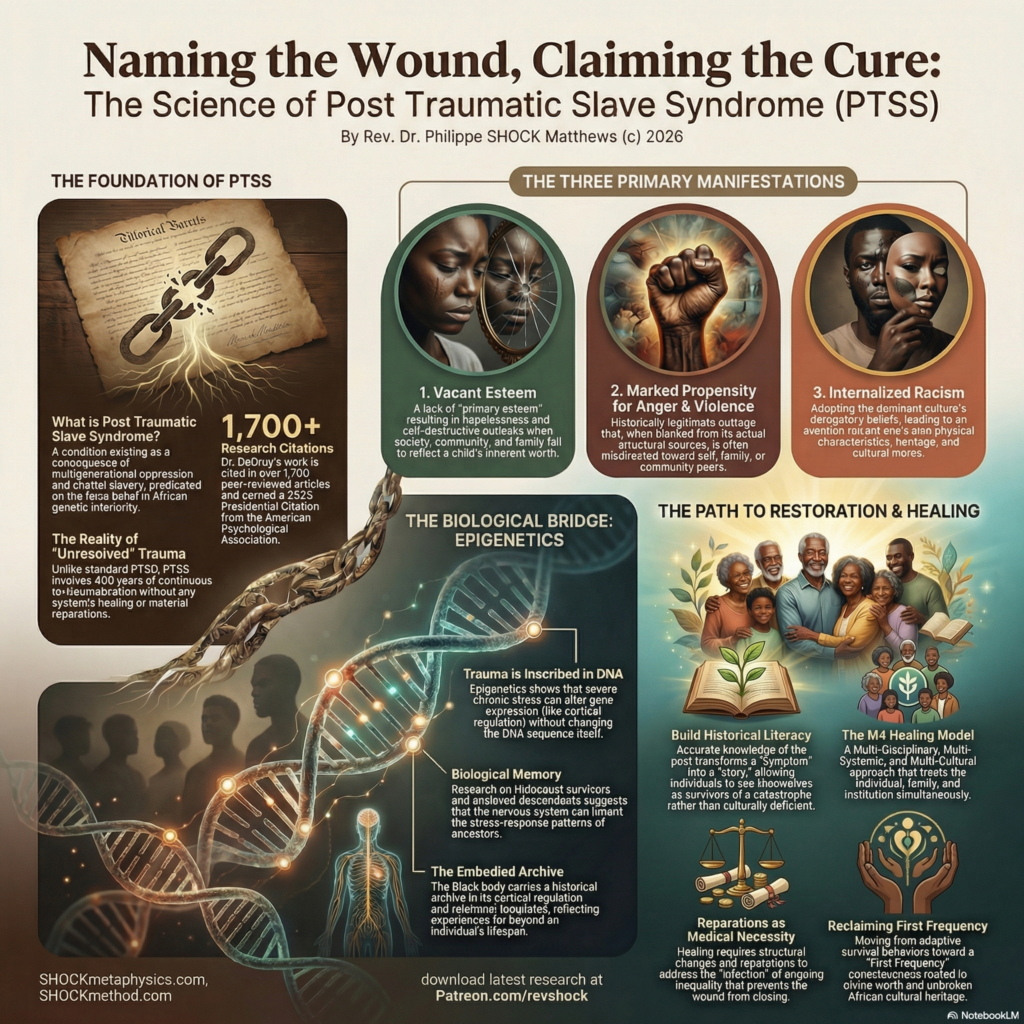
This biographical opening—modest, specific, rooted in working-class Black Los Angeles—is not incidental context. It is the foundation of the epistemological orientation that would distinguish DeGruy’s scholarship from the decades of social science research that had preceded it. The academic study of African American behavior and psychology in the twentieth century was dominated overwhelmingly by white researchers operating from frameworks that either pathologized Black life in isolation from its historical and structural context, or—in better cases—examined racism as an external social variable without fully reckoning with the ways in which centuries of specific, sustained, and systematized trauma had fundamentally altered the psychological landscape of African-descended communities. DeGruy came to this field not as a detached outside observer seeking to categorize a phenomenon. She came as a member of the community the research described—a Black woman formed by Los Angeles’s South Side in the late 1950s and 1960s, shaped by the specific textures of Black working-class life in the post-war era of the Great Migration’s maturation.
Joy attended elementary school, junior high school, and senior high school in Los Angeles Unified School District. She participated in a dual enrollment program that allowed her to complete junior college coursework while a student at Crenshaw High School. Crenshaw High School—located in the heart of South Los Angeles, one of the city’s most storied Black communities—was itself a cultural and intellectual institution with deep roots in African American civic life. That DeGruy was academically accelerated enough to be completing junior college coursework while still a high school student speaks to an intellectual capacity that her subsequent educational trajectory would develop and deploy in the service of something far larger than individual academic achievement.
The Academy and the Making of a Framework
DeGruy’s educational journey is one of extraordinary academic persistence and accumulation, culminating in a scholarly portfolio that remains unusual in its disciplinary breadth. DeGruy holds a bachelor’s of science in Speech Communication from Portland State University, two master’s degrees—in Social Work from Portland State and Clinical Psychology from Pacific University—and a Ph.D. in Social Work and Social Research from Portland State University’s Graduate School of Social Work.
The combination of these three disciplines—communication, social work, and clinical psychology—is not accidental. It reflects a thinker who understands that the problem she is investigating operates simultaneously across multiple registers: the communicative (how Black people understand and narrate themselves and their experiences), the social (how institutional structures shape behavioral patterns across communities), and the clinical (how psychological distress manifests in individual bodies, minds, and behaviors). No single disciplinary lens could capture the full dimensionality of what DeGruy was attempting to map. Her multi-disciplinary credential base gave her the methodological tools to approach the phenomenon from multiple angles simultaneously—a scholarly comprehensiveness that would become one of the defining strengths of the PTSS framework.
Her doctoral dissertation studied predictive variables for African American Male Youth Violence using Sociocultural Theory, Social Learning Theory, and Trauma Theory frameworks. She also employed the “new” theory of Post Traumatic Slave Syndrome, which would later become the subject of her 2005 book. The dissertation title itself—African American Male Youth Violence: Trying to Kill the Part of You that Isn’t Loved—is one of the most phenomenologically precise descriptions of the relationship between anti-Black racial violence and its internalization that has ever appeared in the academic record. The phrase “trying to kill the part of you that isn’t loved” reaches beneath sociological abstraction and clinical categorization to name something that Africana phenomenology has long sought to articulate: the way in which Black people subjected to sustained social invalidation can develop a relationship to their own existence that mirrors the contempt the society around them has performed.
Within the SHOCK Method™ Four Frequencies of Humanity framework, this dissertation title describes the lived experience of Fourth Frequency consciousness with shattering accuracy. The Fourth Frequency—what I identify as the “thug” or adaptive misidentification consciousness—is precisely this: the consciousness that has been so thoroughly deprived of First Frequency recognition of divine worth, so exhaustively shaped by Second and Third Frequency trauma and domestication, that it turns the violence of its own dehumanization back upon itself and its community. DeGruy was, in her very first major scholarly work, doing what the SHOCK Method™ seeks to do: identifying the historical and psychological origins of adaptive survival behaviors in Black communities that are misread by the dominant culture as evidence of Black pathology rather than as evidence of the ongoing injury that anti-Black oppression continuously inflicts.
The Personal Is Phenomenological: Community as Laboratory
It would be a mistake to read DeGruy’s intellectual development as purely an academic progression from undergraduate to doctoral study—as if the ideas arrived from libraries and classrooms alone. The formation of the PTSS framework was deeply embedded in DeGruy’s direct, sustained engagement with African American communities as a social work practitioner, consultant, and community educator across more than three decades of professional practice.
With over thirty years of practical experience as a professional in the mental health field, Dr. DeGruy encourages African Americans to view their attitudes, assumptions, and behaviors through the lens of history and so gain a greater understanding of how centuries of slavery and oppression have impacted people of African descent in America. This positioning—encouraging people to view their behaviors through the lens of history—is the methodological cornerstone of DeGruy’s entire intellectual project. It represents a decisive move away from the dominant paradigm of American mental health practice, which has consistently located the sources of individual distress within the individual psyche (or body) while treating historical and structural forces as background context rather than primary causation.
The Africana phenomenological tradition that grounds the SHOCK Method™ framework has long insisted on precisely what DeGruy’s clinical and scholarly orientation embodies: that Black experience cannot be adequately understood—cannot even be adequately perceived—without continuous reference to the specific historical conditions that have produced it. The Black body that sits in a clinician’s office, navigating depression, hypervigilance, cycles of anger, or the particular ache of a self-concept that cannot find solid ground—that body is not merely a collection of individual psychological variables. It is a historical archive. It carries in its nervous system, its cortisol regulation patterns, its relational templates, and its fundamental orientation toward the social world, the accumulated residue of experiences that extend far beyond its individual lifespan.
DeGruy’s genius was to take this phenomenological insistence—which had been articulated theoretically by Fanon, Du Bois, and others—and submit it to rigorous empirical investigation across twelve years of qualitative and quantitative research. She was not content to assert that slavery’s aftermath was present in contemporary Black life. She was determined to map that presence—to identify its specific behavioral manifestations, its transmission mechanisms, and its relationship to both historical trauma and ongoing racial oppression—in ways that could meet the standards of academic scholarship and speak with authority to the clinical and policy communities that most needed to understand what she was documenting.
The Journey to the Book: Twelve Years of Research
A result of twelve years of quantitative and qualitative research, Dr. DeGruy developed her theory of Post Traumatic Slave Syndrome, publishing her findings in the book Post Traumatic Slave Syndrome: America’s Legacy of Enduring Injury and Healing. Twelve years. This number is worth sitting with. In an academic culture that rewards rapid publication and favors citation counts over depth of investigation, the twelve-year gestation of DeGruy’s foundational work speaks to a scholar who refused to shortcut the evidentiary demands of the question she was investigating. The question itself was profound: What does multigenerational trauma actually do to the descendants of the traumatized? How does it manifest? How does it transmit? And what does healing from it require?
These are not questions that yield to simple or quick answers. They require engagement with history, neurobiology, epigenetics, psychology, sociology, cultural anthropology, and the lived testimony of actual human beings navigating the contemporary expressions of historical injury. DeGruy brought all of these to bear, conducting research in both the United States and Africa, gathering empirical data while simultaneously synthesizing the existing scholarly literature on trauma, epigenetics, and intergenerational transmission, and grounding her theoretical framework in the specific historical record of American chattel slavery and its aftermath.
The book addresses the residual impacts of trauma on African Descendants in the Americas. Post Traumatic Slave Syndrome lays the groundwork for understanding how the past has influenced the present, and opens up the discussion of how we can eliminate non-productive attitudes, beliefs and behaviors developed to cope and survive the traumatic periods of capture, transport, enslavement, Jim Crow and current day racial terrorism. The phrase “current day racial terrorism” is as essential as the historical reference to capture and enslavement. DeGruy’s framework is not simply about the past. It is about the continuity between past and present—the way in which what slavery inaugurated, Reconstruction’s collapse extended, Jim Crow codified, mass incarceration perpetuated, and ongoing police violence continues to inflict. PTSS is not a historical condition that should have resolved itself when legal slavery ended in 1865. It is an ongoing condition, continuously re-traumatized by the continuation of anti-Black institutional violence in its successive historical forms.
The Launch of a Public Intellectual Career
When Post Traumatic Slave Syndrome was first published in 2005 by Uptone Press in Milwaukie, Oregon, it arrived without the institutional backing of a major academic publisher—but it arrived with the force of truth speaking to an experience that millions of African Americans recognized immediately. The book’s rapid spread through Black communities, Black churches, Black professional organizations, and Black educational institutions was not a marketing phenomenon. It was a recognition phenomenon. People were encountering, in formal scholarly language and systematic theoretical framework, something they had felt and known in their bones for their entire lives.
From 2001 to 2014, DeGruy was an assistant professor in the School of Social Work at Portland State University, where she taught core classes in Human Behavior in the Social Environment, Generalist Practice, Field Instruction, and African American Studies. Her academic appointment provided the institutional platform from which her ideas could be transmitted to future generations of social workers, clinicians, and community organizers—the practitioners who would carry PTSS theory into direct application in the communities most urgently in need of its explanatory and healing power.
Dr. DeGruy received the American Psychological Association 2023 Presidential Citation for Scholarship noting 1,700 citations of Post Traumatic Slave Syndrome: America’s Legacy of Enduring Injury and Healing, in refereed journal articles and books. Additionally, she received a MacArthur Foundation Grant for Reparations and Healing from July 2021 through August 2022 totaling $500,000. These recognitions—from the nation’s premier psychological professional organization and from one of the country’s most prestigious philanthropic institutions—represent the formal academic and institutional acknowledgment of what the Black community had already recognized: that DeGruy’s work had permanently changed what responsible scholarship about African American experience must account for.
Dr. DeGruy’s appointment as a Provost’s Distinguished Visiting Scholar at Morehouse College—one of the nation’s leading HBCUs—comes as a fitting recognition of more than 25 years of groundbreaking scholarship. Her research has been foundational in broadening understanding the lived experiences of African Americans, especially Black boys and men.
The biographical arc that moves from working-class South Los Angeles, through the dual enrollment halls of Crenshaw High School, through multiple graduate degrees and twelve years of sustained empirical research, to a Presidential Citation from the APA, a MacArthur grant, and a distinguished appointment at Morehouse College—this is not merely a story of individual academic achievement. It is a story of intellectual sovereignty: of a Black woman who took the lived experience of her community, refused the inadequate explanations that existing scholarship offered, and built a new framework capable of holding the full historical and phenomenological weight of what African American people have actually experienced and continue to experience. The specific content of that framework—its theoretical architecture, its behavioral categories, its epigenetic dimensions—is the subject of Part Two.
One Response