
By Rev. Dr. Philippe SHOCK Matthews
Research Scientist in Africana Phenomenology and Metaphysical Minister of Mental Liberation
I want to tell you something I have not said publicly until now: I almost didn’t write this book.
Not because I didn’t have anything to say — I have been saying it, in sessions, on this podcast, in the design of BlackLoveGPT itself, for years. I almost didn’t write it because I was afraid a book would feel like repeating myself. Then I sat with a client — I’ll call her Nia, with her permission to share the shape of her story — who told me something that changed my mind entirely. She said, “I open the app when I’m in crisis. But I don’t know how to think about my relationship when I’m not in crisis. I need something I can sit with, not just something I can ask.”
That sentence is the reason the BlackLoveGPT Handbook exists.
The Question Beneath the Question
Everyone keeps asking me, “Why write a book when you already built the AI tool?” That is the surface question. The real question—the one Nia handed me without meaning to—is this: What does a relationship need that a conversation cannot give?
An AI tool, even one built with as much care and cultural grounding as BlackLoveGPT, meets you in the moment. It answers the question you ask right now, at 11:47 p.m., when your chest is tight, and you need something immediately. What it cannot do — what no chat interface can do — is sit beside you over weeks and months while a pattern slowly becomes visible to you. A book can be underlined. A book can be returned to. A book can sit on a nightstand as evidence you are doing the work, even on nights you are too tired to open an app.
Why a Trauma-Informed Relationship Needs a Physical Companion, Not Just a Prompt
Trauma healing is not a single insight — it is a slow, repeated re-patterning of the nervous system and the belief system underneath it. Research on relationship regulation shows that our nervous systems learn new patterns through repetition and physical, embodied practice, not through information alone (Sbarra & Hazan, 2008; Bradford et al., 2026). A single powerful answer from a tool can open a door. But walking through that door — and walking back through it again and again until the pattern actually shifts — requires something you can hold, revisit, write in, and sit with in silence. That is a different kind of technology. It is a slower one. And healing has never been fast.
The Handbook was built to be that slower companion — chapters organized around the same SHOCK Method framework this podcast has taught all along, but expanded into full reflection exercises, guided journaling prompts, and real relationship scenarios drawn from years of counseling Black couples and individuals through attachment wounds, algorithmic dating fatigue, performance-intimacy, and nervous system rupture.
An Africana Phenomenological Interpretation of Why This Book Had to Exist
Writing this Handbook was, for me, an act of Radical Self Evolution (RSE) — the discipline of consciously choosing a new pattern instead of repeating an inherited one. For generations, Black love has too often been forced to organize itself around survival rather than around the First Frequency — that original, divine consciousness where love is safe, uncomplicated by armor, and does not require constant proof.
Instead, so much of what gets passed down as “how Black people love” is actually Second Frequency consciousness — trauma-induced patterns of hypervigilance and self-protection — dressed up in Third Frequency respectability (“keep it together for the family,” “don’t air this out”) or hardened into Fourth Frequency adaptive misidentification (“love is a battlefield, get yours first”). None of these are who we actually are. They are what happened to us, running the program of intimacy in our place.
The Trinity of Black Trauma — historical, systemic, and psychological injury — did not just shape how we date. It shaped what we believe love can even be. The Handbook exists because a chatbot, however well-designed, cannot walk a person through that full arc of historical naming, systemic recognition, and psychological reclamation. A book can. A book has room to breathe the way this healing needs to breathe.
I didn’t write this book to tell you something new. I wrote it so you would have something to hold onto long enough for the truth you already carry to finally feel real.
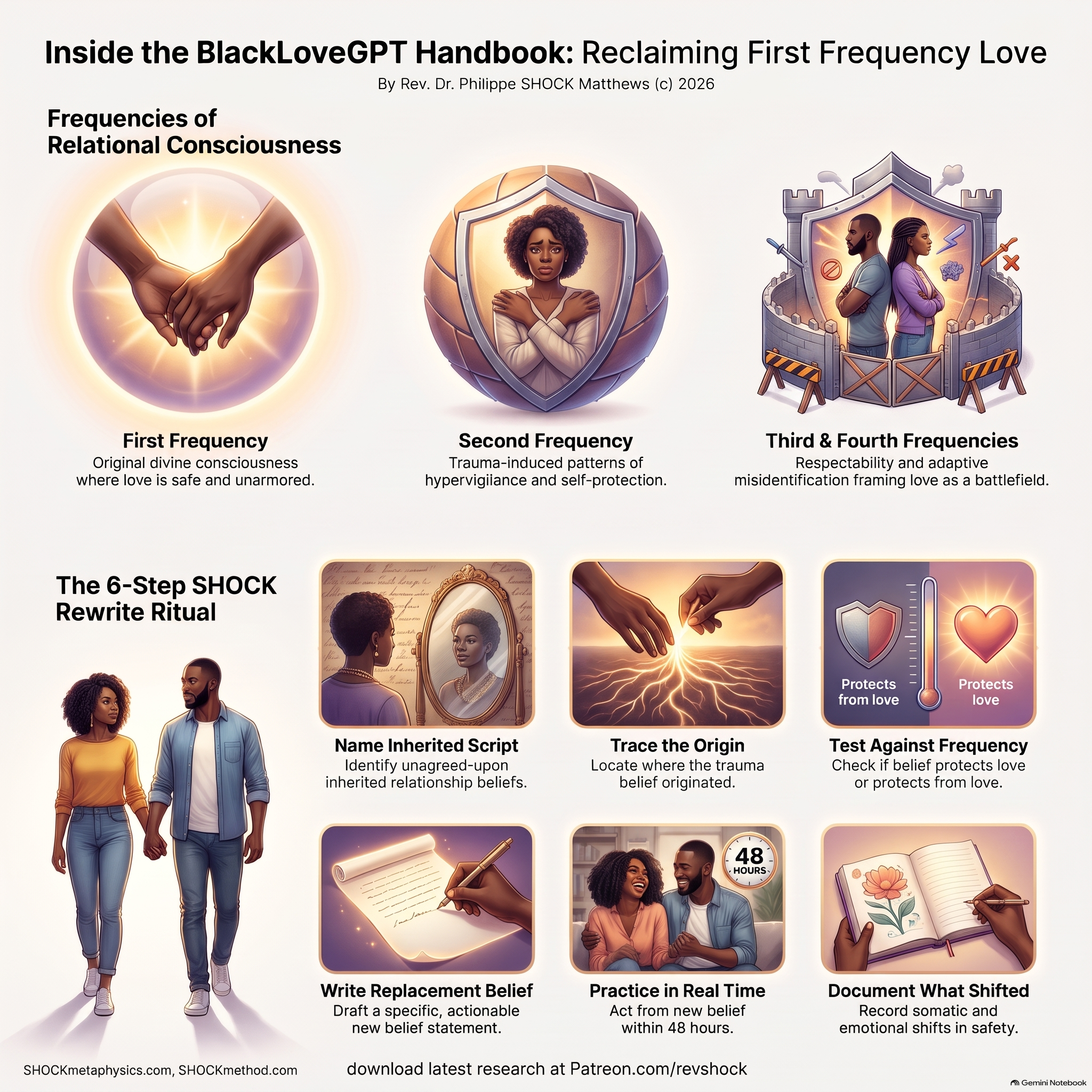
The SHOCK Rewrite Ritual
This is the same practice I used, chapter by chapter, while writing the Handbook — and it is now a core exercise inside it. Use it with any inherited relationship belief you are ready to examine.
1. Name the Inherited Script. Write down one belief about love you were handed without ever agreeing to it — something like “love means proving your loyalty” or “vulnerability is dangerous.”
2. Trace the Origin. Ask where that belief actually came from. A grandmother’s survival wisdom? A systemic wound? A past relationship rupture that never got named? Locate it honestly, without judgment.
3. Test It Against First Frequency. Ask: does this belief protect love, or does it protect me from love? Beliefs born from trauma almost always protect against connection, not for it.
4. Write the Replacement, Not Just the Rejection. Do not simply cross the old belief out. Write, in your own words, what you want to believe instead — and make it specific enough to act on this week.
5. Practice It in One Real Moment. Choose one real interaction in the next 48 hours to consciously act from the new belief instead of the old script, even if it feels unfamiliar.
6. Document What Happened. Write down what shifted — in your body, your relationship, your sense of safety. This is how a new frequency becomes your default, not an exception.
An Invitation, Not Just an Announcement
Later this week, I am doing something I have never done before: I’m going live to read from the Handbook for the first time, publicly, before it is even in anyone’s hands — and to open pre-orders while we’re together in that space. I want you there. Not because I need an audience, but because this book was written for the people who have been on this journey with me all month — through attachment wounds, through Ma’at, through the algorithmic bias that shapes who we even get shown as possible partners, through the SHOCK Method applied to real couples, through Second Frequency performance-intimacy, and now, finally, through the nervous system work that holds all of it together.
This Handbook is the culmination of that throughline. Come hear it before anyone else does.
Pre-order the Handbook now at $3.99 — the price this month only, before it rises to $9.99 at its official December 1st launch: Pre-Order the BlackLoveGPT Handbook →
You Do Not Have to Keep Carrying This Alone
Recognizing the pattern matters—but recognition without intervention can leave you naming the wound repeatedly without changing what it’s doing to your life.
The SHOCK Method helps you identify the trauma patterns influencing your thoughts, emotions, relationships, nervous system, and sense of self. This culturally grounded, trauma-informed approach integrates Africana phenomenology, metaphysical spiritual care, somatic regulation, and practical tools for reclaiming personal agency.
If this article described something you are currently experiencing, your next step may be a private SHOCK Trauma Spiritual Counseling Discovery Call with Rev. Dr. Philippe SHOCK Matthews. In this focused session, we will examine what is happening beneath the visible problem, identify patterns that may be keeping you stuck, and determine whether SHOCK Method counseling is right for your needs.
Ready for personal support?
Book Your SHOCK Method Discovery Call: https://shockmetaphysics.gumroad.com/l/discoverycall
Continue the Work
Support this research and receive deeper teachings, members-only content, and expanded resources through Patreon.
Join Rev. SHOCK on Patreon: https://www.patreon.com/revshock
Pre-Order the BlackLoveGPT Handbook
https://amzn.to/4xW6gvJ
Nothing is wrong with Black people. Something happened to Black people—and we can name, understand, interrupt, and transform it.
References
Bradford, A. B., Werner, A. G., & Johnson, L. N. (2026). I feel you … or do I? An investigation of therapist presence and partner effects via physiological synchrony in couple therapy. Journal of Marital and Family Therapy, 52(2), Article e70125. https://doi.org/10.1111/jmft.70125
Sbarra, D. A., & Hazan, C. (2008). Coregulation, dysregulation, self-regulation: An integrative analysis and empirical agenda for understanding adult attachment, separation, loss, and recovery. Personality and Social Psychology Review, 12(2), 141–167. https://doi.org/10.1177/1088868308315702