
The Question Beneath the Question
“Why does it still feel empty when everything looks right?” That is the question I hear most often from people who, on paper, are doing everything a “good partner” is supposed to do — remembering anniversaries, saying “I love you” on cue, showing up to the family functions, doing the relationship checklist correctly — and still lying next to someone at night feeling profoundly alone.
The surface question is “what’s wrong with my relationship?” The question beneath the question is: “Have I ever actually let myself be felt by another person, or have I only ever let myself be watched?”
There is a difference between performing closeness and feeling close. The body knows the difference even when the mind has gotten very good at not noticing.
A Trauma-Informed Explanation
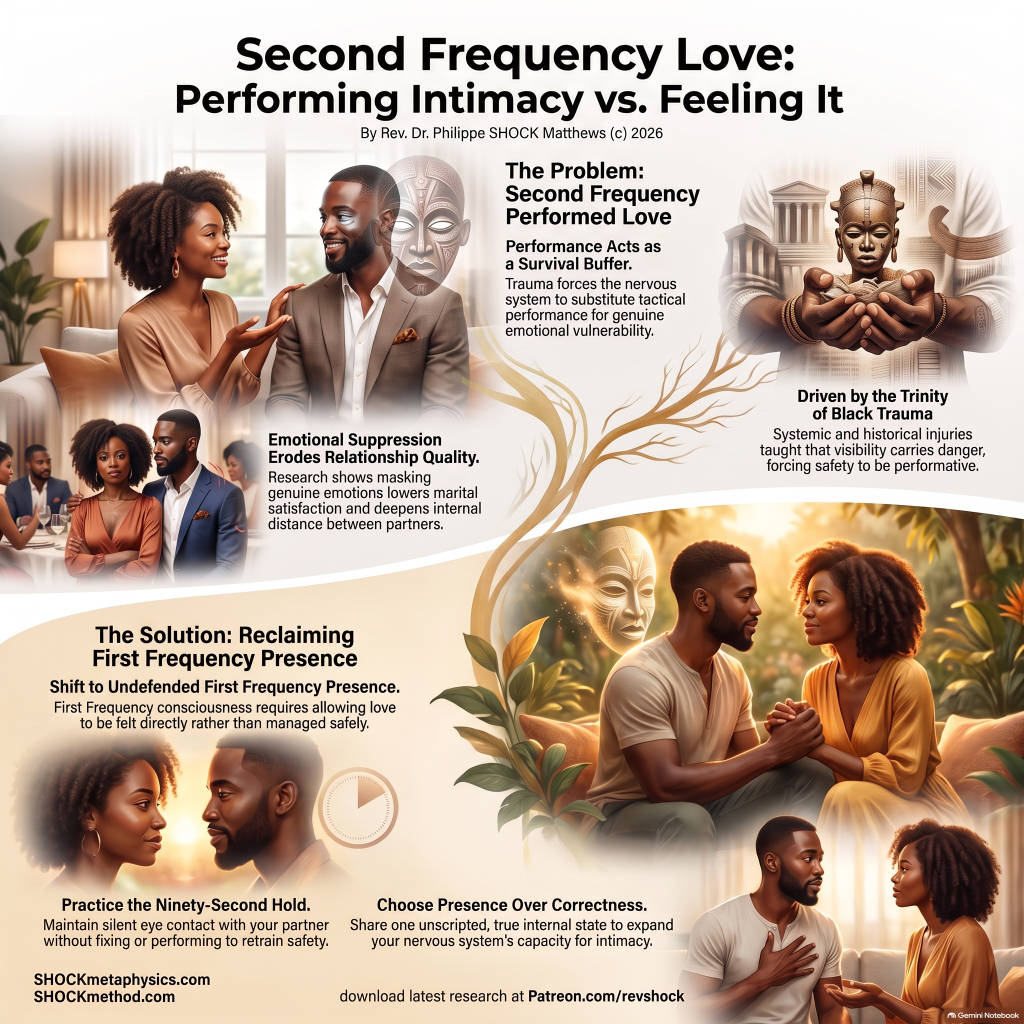
Trauma teaches the nervous system that being fully seen is dangerous. If vulnerability was met, at some point in your history, with abandonment, ridicule, punishment, or unpredictability, your body learned a survival equation: visibility equals risk. From that point forward, the nervous system does something remarkably intelligent and remarkably costly — it keeps you in relationship, because isolation is also dangerous, but it manages the relationship from a safe distance, using performance as the buffer.
Performance in intimacy looks like: saying the “right” romantic thing without feeling the tenderness behind it. Going through the motions of affection — the hug, the check-in text, the anniversary gesture — as a transaction that keeps the peace rather than an expression of a felt experience. Anticipating your partner’s needs with technical precision while your own inner world stays sealed off, unreachable even to you. From the outside, this can look like a “good” relationship. From the inside, it can feel like running a very competent customer service department for someone you are supposed to love.
This is not manipulation, and it is not coldness. It is a nervous system doing its job — protecting a self that once learned intimacy was not safe to enter fully. The tragedy is that the protection, once necessary, now prevents the very thing the person most wants: to be known and to stay.
An Africana Phenomenological Interpretation
This is precisely the territory the Four Frequencies of Humanity framework was built to name. First Frequency is our original, divine consciousness — the birthright capacity for undefended presence, where love is felt rather than managed. Second Frequency is trauma-induced consciousness, where the nervous system organizes around threat detection and self-protection, even inside relationships that are, in the present moment, safe.
Second Frequency love is love conducted from behind glass. It can say all the right words. It can perform every gesture correctly. What it cannot do — until the nervous system is taught otherwise — is drop the guard long enough to actually feel the safety that is, in fact, available. This is why so many people in Second Frequency relationships report feeling “unfulfilled” by partners who, by every external measure, do everything right. The problem was never solely the partner. Both people were performing intimacy at each other across a gap neither had the tools to close.
This performance often intersects with Third Frequency — the domesticated, assimilated “good negro” identity, shaped by generations of Black people needing to perform acceptability, agreeableness, and non-threat to survive in hostile systems. When that survival performance migrates from the workplace and the world into the bedroom and the relationship, it produces partners who are exceptional at appearing fine, composed, and devoted — and who have quietly lost access to the more chaotic, tender, unscripted parts of themselves that real intimacy requires.
Underneath both frequencies sits the Trinity of Black Trauma. Historical injury taught that outside forces could break Black bonds at any moment, so why invest fully. Systemic injury taught that visibility — being truly seen — carried danger in a world built to surveil and punish Black bodies, and that lesson does not stay neatly outside the bedroom door. Psychological injury internalized both into a belief that safety must be earned through performance rather than received through presence.
Moving from Second Frequency love toward First Frequency love — the work of Radical Self Evolution — does not require finding a “safer” partner. It requires the slower, riskier work of teaching your nervous system, often for the first time, that it can stop performing and start feeling, one small moment of undefended presence at a time.
You do not fall out of love with someone by drifting apart. You fall out of feeling by staying so guarded for so long that even love starts to feel like a role you play.
What the Research Shows
This pattern is not only a spiritual or phenomenological observation — it has empirical support in relationship science. A longitudinal study of 229 newlywed couples tracked how habitually each spouse suppressed their emotions and how each rated the marriage five months and two years after the wedding. Husbands’ habitual suppression was the most consistent predictor of lower marital quality over time, and wives proved especially sensitive to their partners’ use of suppression (Velotti et al., 2016). In other words, muting genuine emotional experience in the presence of a partner does not protect a relationship — it quietly erodes it, even when the performance looks, on the surface, like devotion.
This finding echoes what Africana phenomenology calls spiritual: the body cannot be fooled by a performance the soul isn’t actually feeling, and neither, eventually, can the person lying next to you.
The Undefended Moment: A SHOCK Method Exercise for Reclaiming First Frequency Intimacy
This exercise is designed to be practiced with a willing partner, in a low-stakes moment — not mid-conflict — to begin rebuilding the nervous system’s tolerance for undefended presence.
- Name the Frequency Without Judgment. Each partner silently identifies: “Right now, am I performing connection, or am I feeling it?” There is no wrong answer — only honest data.
- Choose One True Sentence. Each partner shares one true, unscripted sentence about their actual internal state in this moment — not what sounds good, not what keeps the peace, but what is actually true. Example: “I feel nervous saying this out loud.”
- Practice the Ninety-Second Hold. After sharing, both partners sit in eye contact and silence for ninety seconds without fixing, responding, or performing reassurance. The nervous system needs unstructured time to register that nothing bad happens when it is truly seen.
- Track the Body, Not the Script. Each partner notices, out loud, one physical sensation that arose during the hold — tightness, warmth, an urge to look away. This retrains attention toward felt experience instead of managed appearance.
- Choose Presence Over Performance, On Purpose. Close the exercise by naming one small way you will choose felt presence over performed correctness in the next 24 hours — a real laugh instead of a polite one, a genuine “I don’t know” instead of a reassuring script.
You Do Not Have to Keep Carrying This Alone
Recognizing the pattern matters — but recognition without intervention can leave you repeatedly naming the wound without changing what it does to your life.
The SHOCK Method helps you identify the trauma patterns influencing your thoughts, emotions, relationships, nervous system, and sense of self. This culturally grounded, trauma-informed approach integrates Africana phenomenology, metaphysical spiritual care, somatic regulation, and practical tools for reclaiming personal agency.
If this article described something you are currently experiencing, your next step may be a private SHOCK Trauma Spiritual Counseling Discovery Call with Rev. Dr. Philippe SHOCK Matthews. In this focused session, we will examine what is happening beneath the visible problem, identify patterns that may be keeping you stuck, and determine whether SHOCK Method counseling is right for you.
Ready for personal support?
Book Your SHOCK Method Discovery Call
Continue the Work
Support this research and receive deeper teachings, members-only content, and expanded resources through Patreon.
Join Rev. SHOCK on Patreon
Pre-Order the BlackLoveGPT Handbook
This month only, pre-order the BlackLoveGPT Handbook for just $3.99 — the price rises to $9.99 when it officially launches December 1st.
Pre-Order the BlackLoveGPT Handbook →
Go Deeper Weekly
Subscribe to the Substack
Nothing is wrong with Black people. Something happened to Black people — and what happened can be named, understood, interrupted, and transformed.
References
Velotti, P., Balzarotti, S., Tagliabue, S., English, T., Zavattini, G. C., & Gross, J. J. (2016). Emotional suppression in early marriage: Actor, partner, and similarity effects on marital quality. Journal of Social and Personal Relationships, 33(3), 277–302. https://doi.org/10.1177/0265407515574466