
By Rev. Dr. Philippe SHOCK Matthews
Research Scientist in Africana Phenomenology and Metaphysical Minister of Mental Liberation
There is a moment in almost every counseling session I have ever sat in with a Black couple where the content of the argument stops mattering. The dishes, the disrespected mother, the late text message — all of it falls away, and what is left in the room is two nervous systems locked in a fight neither person consciously chose. I have watched partners who love each other deeply become strangers for a few minutes, wearing the faces of people they trust. That is not a communication problem. That is a nervous system problem. And until we treat it as one, we will keep sending Black couples back into the same rupture with better vocabulary and the same unregulated bodies.
The Question Beneath the Question
The surface question most couples bring me is: “Why do we keep having the same fight?”
The question beneath that question is the one that actually opens the door to healing: Whose nervous system is running this argument right now — and when did it first learn to run that way?
Almost no couple has been taught to ask this. We are taught to interrogate what was said. We are rarely taught to interrogate what our body decided was a threat before a single word was spoken. Every relationship has its own nervous system — a shared physiological climate that either partner can raise or lower, often without either realizing it.
What Is Actually Happening in Your Body When the Relationship Feels Unsafe
Your autonomic nervous system does not know the difference between “my partner raised their voice” and “my life is in danger.” It only knows arousal and safety. When a partner’s tone shifts, when eye contact disappears, when an old wound gets grazed, the body can move into fight (raised voice, criticism, control), flight (withdrawal, shutting the conversation down, leaving the room), freeze (going blank, dissociating mid-conversation), or fawn (over-apologizing, abandoning your own position just to restore calm).
None of these are character flaws. They are survival responses, and in a trauma-informed frame, they are intelligent. The nervous system is doing exactly what it was trained to do — the problem is that it was trained in an environment where danger was real, and it has not yet learned that this partner, in this moment, is not that danger.
This is where co-regulation becomes essential. Co-regulation is the process by which one regulated nervous system helps steady another — the way an infant’s heart rate settles against a calm caregiver’s chest, or the way your breathing slows next to someone who is genuinely at peace. Researchers describe it as a real physiological exchange between people who are close to one another, not merely a metaphor.
The inverse is also true. Two dysregulated nervous systems in close proximity do not cancel each other out — they can amplify each other. This is co-dysregulation, and it is the invisible engine behind many “we keep having the same fight” cycles.
An Africana Phenomenological Interpretation
To understand why so many Black couples carry heightened nervous systems into love, we have to look through the Trinity of Black Trauma — historical, systemic, and psychological injury — because none of these wounds live only in the mind. They live in the body, and the body is what shows up in the relationship.
Historical injury shaped the very template for Black attachment. Enslavement systematically and deliberately disrupted Black families — partners sold apart, children separated from parents, kinship bonds severed by design as a tool of control. A nervous system descended from that rupture did not inherit a neutral starting point for intimacy; it inherited an ancestral imprint that closeness can be taken without warning, and that vigilance is safer than trust.
Systemic injury means many Black partners walk through their entire day in a state of low-grade hypervigilance before they ever walk through the front door — coded language at work, surveillance in public space, the constant metabolizing of racial threat. By the time two people are finally alone together, their regulatory reserves may already be spent. The relationship is not the first place the nervous system got activated today. It is often the last stop for an alarm system that has been ringing since morning.
Psychological injury is where those first two wounds become internalized belief: I am too much. I am not safe to need. If I relax, something will go wrong. These beliefs do not stay in the mind — they become the felt sense the body brings into every disagreement.
This is also where the Four Frequencies of Humanity become useful diagnostic language. The First Frequency is our original, divine consciousness — the state in which love doesn’t require performance, protection, or proof. Most couples are not fighting in First Frequency. They are fighting in Second Frequency — trauma-induced consciousness — where old alarm patterns hijack present-moment connection, and partners begin reacting not to each other, but to the ghosts each of them carries. Co-regulation, practiced intentionally, is one of the most direct pathways back to First Frequency partnership — and a core expression of Radical Self Evolution (RSE): the discipline of consciously interrupting an inherited pattern rather than automatically repeating it.
Your nervous system is not the enemy of your love story — it is the oldest member of your relationship, and it has never once stopped trying to keep you safe.
What the Research Shows
This is not only spiritual and phenomenological language — physiology is part of the picture. A 2026 study in the Journal of Marital and Family Therapy recorded respiratory sinus arrhythmia, electrodermal activity (a marker of nervous system arousal), and pre-ejection period from 33 married couples and their therapist during the first couple-therapy session (Bradford, Werner, & Johnson, 2026). The researchers found strong “physiological inertia” among clients — meaning each person’s autonomic state was driven largely by their own prior arousal rather than by what was happening around them. In plain terms: early on, people are often reacting to their own internal momentum, not to the partner in front of them.
Even so, influence still crossed bodies. In the study, the therapist’s electrodermal activity predicted husbands’ electrodermal activity early in the session, and wives’ electrodermal activity predicted husbands’ later in the session. That is a modest finding from a single session, and it does not prove that one calm nervous system will settle another. But it fits what many Black couples have long sensed intuitively: the nervous system you are closest to does affect your own. That can work against you, spiraling two activated systems into shared crisis. Or, practiced with intention, it can become one of the most powerful healing tools available to a relationship.
This also aligns with earlier foundational work on adult attachment, which describes how close partners can act as regulators of each other’s stress physiology — for better and for worse (Sbarra & Hazan, 2008). A note on scope: the Bradford and colleagues sample was not specific to Black couples, and the Africana phenomenological reading in this article is an interpretive lens I bring to the science, not a finding of the study.
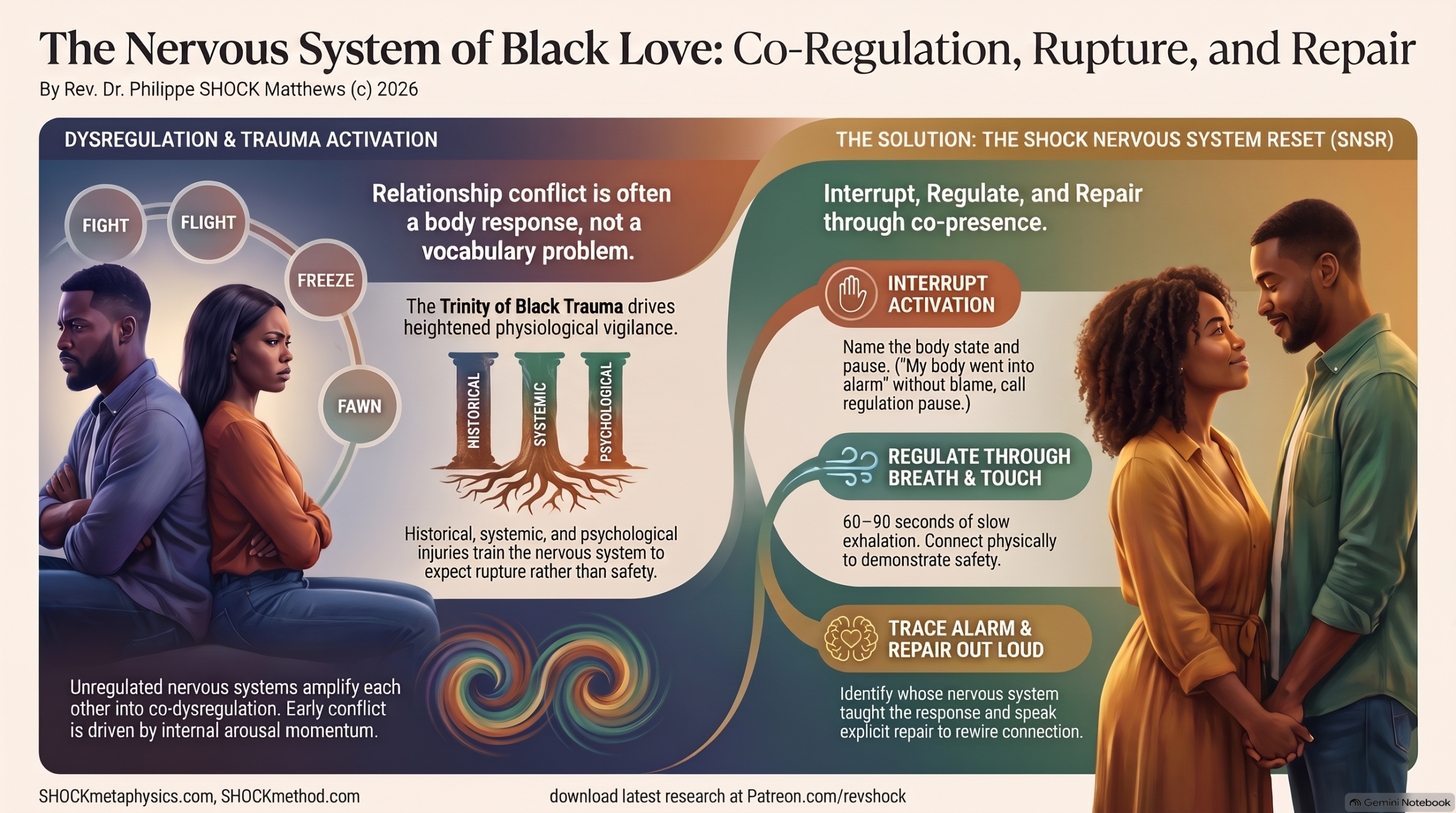
The SHOCK Nervous System Reset (SNSR)
This is a six-step practice for couples to use the moment either partner notices activation rising — before the argument takes over.
- Name the Body, Not the Blame. The moment either partner notices heat rising — chest tightening, jaw clenching, voice sharpening — say it out loud without accusation: “My body just went into alarm.” This interrupts the automatic story that the other person is the danger.
- Call the Pause, Not the Fight. Either partner can call a regulation pause using an agreed-upon word or phrase established in a calm moment beforehand. This is not stonewalling. It is a boundary that protects the relationship from Second Frequency reactivity.
- Return to the Breath Before Returning to the Words. Take sixty to ninety seconds of slow, extended exhale breathing — separately if needed. Do not try to resolve anything while either nervous system is still activated. Words spoken from activation rarely repair; they usually re-wound.
- Offer the Body as Evidence of Safety. Once both partners are calmer, reconnect physically if welcomed — a hand on a hand, sitting closer, eye contact held without demand. This is co-regulation in action: one steadier nervous system helping another find the floor again.
- Name the Old Alarm. Gently ask: “Whose nervous system taught us to respond this way?” Trace the reaction back to its origin — historical, systemic, or psychological — rather than treating it as evidence about your partner’s character.
- Repair Out Loud. Close the cycle with a spoken repair: what happened, what each person needed, and one specific thing each partner will try differently next time. Repair spoken aloud teaches the nervous system to expect connection, not abandonment, from conflict.
You Do Not Have to Keep Carrying This Alone
Recognizing the pattern matters — but recognition without intervention can leave you repeatedly naming the wound without changing what it does to your life.
The SHOCK Method helps you identify the trauma patterns influencing your thoughts, emotions, relationships, nervous system, and sense of self. This culturally grounded, trauma-informed approach integrates Africana phenomenology, metaphysical spiritual care, somatic regulation, and practical tools for reclaiming personal agency.
If this article described something you are currently experiencing, your next step may be a private SHOCK Trauma Spiritual Counseling Discovery Call with Rev. Dr. Philippe SHOCK Matthews. In this focused session, we will examine what is happening beneath the visible problem, identify patterns that may be keeping you stuck, and determine whether SHOCK Method counseling is right for your needs.
Ready for personal support?
Book Your SHOCK Method Discovery Call →
Continue the Work
Support this research and receive deeper teachings, members-only content, and expanded resources through Patreon.
Join Rev. SHOCK on Patreon →
Pre-Order the BlackLoveGPT Handbook →
Nothing is wrong with Black people. Something happened to Black people — and we can name, understand, interrupt, and transform it.
References
Bradford, A. B., Werner, A., & Johnson, L. N. (2026). I feel you … or do I? An investigation of therapist presence and partner effects via physiological synchrony in couple therapy. Journal of Marital and Family Therapy, 52(2), Article e70125. https://doi.org/10.1111/jmft.70125
Sbarra, D. A., & Hazan, C. (2008). Coregulation, dysregulation, self-regulation: An integrative analysis and empirical agenda for understanding adult attachment, separation, loss, and recovery. Personality and Social Psychology Review, 12(2), 141–167. https://doi.org/10.1177/1088868308315702