
The Question Beneath the Question
Most couples who come to me asking “how do we communicate better?” are not actually asking about communication. Communication is the surface question. The question beneath the question is almost always: “Is it safe to need you?”
Every argument about who forgot what, who said what tone, who didn’t text back fast enough — underneath all of it sits a nervous system asking a much older question. Not “will you fix this disagreement,” but “will you stay when I show you the parts of me that have been hurt before, by people who were not you.” Couples do not rupture over dishes. They rupture over unmet bids for safety that go back further than the relationship itself.
If you are only treating the argument, you will manage the same fight for years. If you treat the question beneath the question, you start doing the work that actually changes the relationship.
A Trauma-Informed Explanation
Trauma is not only what happened to you individually — it is also what happens between two people who are both carrying what happened to them. In a partnership, two nervous systems meet, and both are running protective programs installed long before the relationship began. When conflict erupts, you are rarely seeing your partner’s character. You are seeing their nervous system’s best guess at how to survive perceived threat, layered on top of yours.
This is why rupture — a moment of disconnection, hurt, or misattunement between partners — is not evidence that a relationship is broken. Rupture is inevitable in any relationship where two real people are present. What determines the health of the relationship is not whether rupture happens, but whether repair happens afterward, and how quickly, and how genuinely.
Repair is a skill. It is trainable. And it is one of the most well-documented predictors of relationship survival in the couples therapy research literature (more on that below). But repair cannot be taught as a communication technique alone, because most repair failures are not communication failures — they are trauma responses mistaken for character flaws. A partner who shuts down mid-conversation is not “avoidant by nature.” A partner who escalates quickly is not “just dramatic.” These are protective adaptations, and they deserve to be understood as such before they can be interrupted.
This is where a trauma-informed framework becomes necessary. You cannot repair what you have not first understood.
An Africana Phenomenological Interpretation
For Black couples specifically, the work of repair carries an additional layer that most mainstream couples therapy models were never built to hold: the Trinity of Black Trauma — historical injury, systemic injury, and psychological injury — does not stay outside the relationship. It comes home with both partners and sits at the dinner table.
Historical injury shows up as inherited templates for love that were shaped under conditions where Black intimacy itself was structurally disrupted — families separated, bonds treated as disposable, tenderness made a liability. Systemic injury shows up as the chronic stress of navigating anti-Black systems all day and returning home with a depleted nervous system, mistaking exhaustion for indifference. Psychological injury shows up as the internal architecture — the beliefs about worthiness, safety, and trust — that both partners bring into the room, often without either of them naming it aloud.
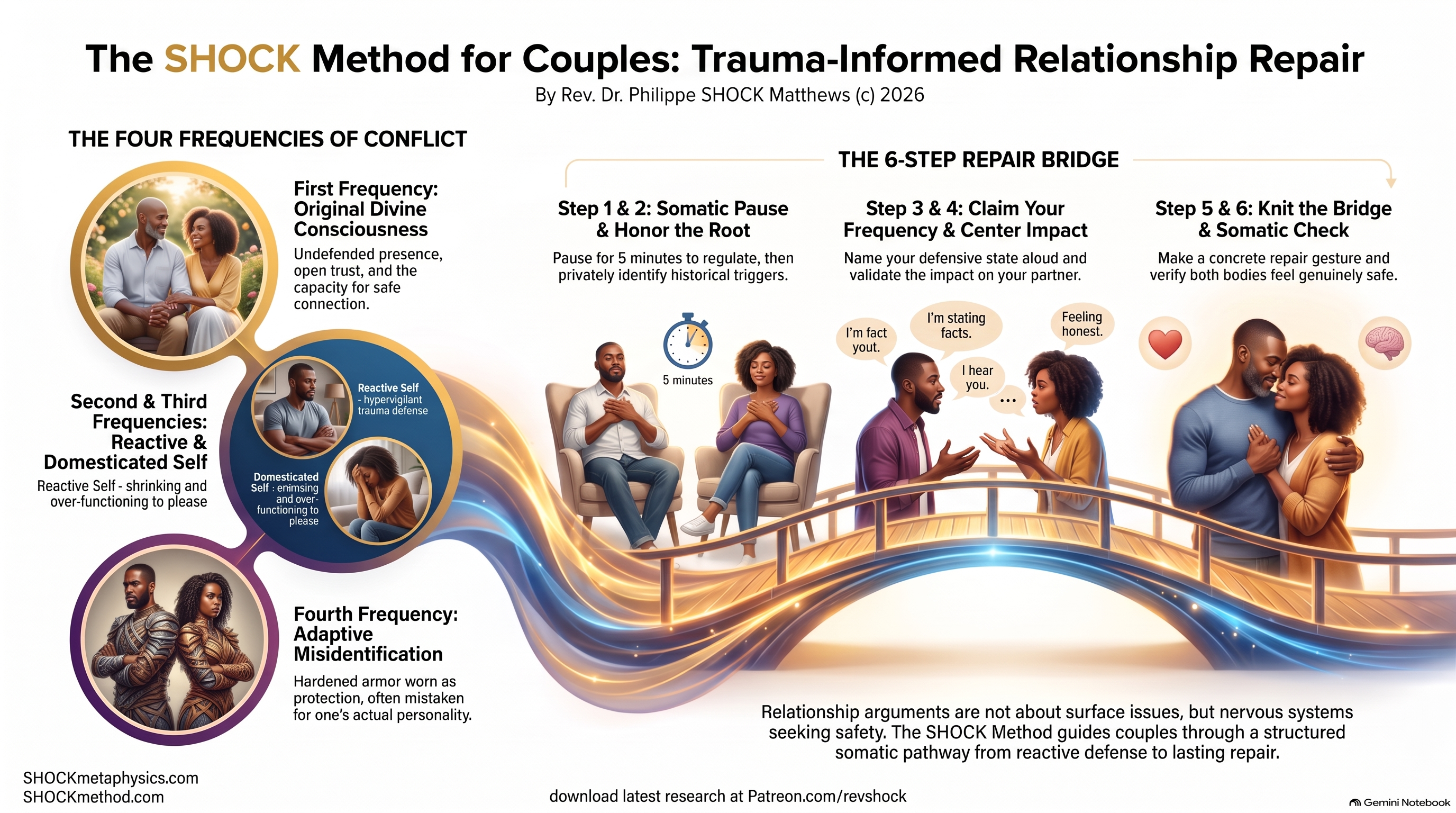
I teach the Four Frequencies of Humanity to locate where a couple is actually operating from, beneath the content of their conflict. First Frequency is original, divine consciousness — the capacity for undefended presence. Second Frequency is trauma-induced consciousness — hypervigilance, defense, performance. Third Frequency is the domesticated, assimilated “good negro” identity — the self that has learned to shrink, please, and over-function to be acceptable. Fourth Frequency is adaptive misidentification — armor worn so long it gets mistaken for a personality, often coded as “thug” or “hard” by a world that punished softness.
Two partners, each defending from Second, Third, or Fourth Frequency, cannot repair each other. They can only escalate each other’s defenses. Repair becomes possible the moment even one partner can find enough safety to return, even briefly, to First Frequency—undefended, present, and willing to be seen without armor. This is not weakness. In a world that trained Black people to armor up to survive, choosing to disarm with your partner is one of the most radical acts of Radical Self Evolution available — proof that the nervous system can be re-taught that safety with another person is possible.
What the Research Shows
The idea that repair—not the absence of conflict—predicts relationship survival isn’t just a metaphysical claim. It is one of the most consistently replicated findings in couples therapy research.
A review of over three decades of outcome research on Emotionally Focused Therapy (EFT) for couples found that EFT produces significant, durable improvements in relationship satisfaction by directly targeting attachment-related emotional cycles — the pattern where one partner’s protective withdrawal triggers the other partner’s protective pursuit, and vice versa, until both are locked in a loop neither can exit alone (Wiebe & Johnson, 2016). The review noted that couples who work through these cycles in structured therapy do not just reduce conflict; they report measurable increases in felt security with their partner that persist after treatment ends.
Separately, foundational research on “attachment injuries” — specific incidents of abandonment or betrayal that become frozen, unresolved wounds inside a relationship — found that these injuries function almost identically to individual trauma symptoms: intrusive replaying of the event, hypervigilance around the topic, and avoidance of vulnerability with the partner who caused the injury (Johnson, Makinen, & Millikin, 2001). Critically, the same research found that these injuries can be resolved through a structured repair process, and that couples who successfully worked through an attachment injury showed lasting change in how safe they felt with each other months later.
Both studies share the same clinical throughline I teach through the SHOCK Method: rupture is not the end of the story. When rupture is understood, named, and structurally repaired, it becomes a place where trust deepens rather than erodes.
You do not need a relationship without rupture. You need a relationship where rupture no longer means abandonment.
The Repair Bridge: A SHOCK Method Exercise for Couples
This is a structured exercise I walk couples through when a rupture has occurred and both partners are willing to engage the repair process together. Do not skip steps — the order matters, because each step regulates the nervous system enough to make the next step possible.
- Stop and Separate (Somatic Pause). Before any words are exchanged about the rupture itself, both partners take five minutes apart to regulate the body — breath, water, stillness. Repair conversations started from a dysregulated nervous system almost always become re-ruptures.
- Historicize the Reaction (Honor the Root). Each partner privately asks: “What does this rupture remind my body of, from before this relationship?” This is not about blaming the past — it is about recognizing when 20% of the charge is about today and 80% is about something older.
- Own Your Frequency (Claim the Pattern). Each partner names, out loud to the other, which Frequency they were defending from in the moment — Second (fight/flight), Third (over-functioning/appeasing), or Fourth (armored/shut down). Naming it out loud interrupts its automatic grip.
- Center the Impact, Not Just the Intent (Compassionate Accountability). The partner who caused harm acknowledges the impact of their action on the other, separate from whether they “meant it that way.” This step alone resolves more ruptures than any other.
- Knit the Bridge (Structured Repair Attempt). Using language both partners pre-agree on ahead of time (a phrase, a touch, a signal), the couple makes a concrete repair gesture — not a general “I’m sorry,” but a specific acknowledgment of what happened and what will be different moving forward.
- Confirm Reconnection (Somatic Check). Before ending the conversation, both partners check in on their bodies, not just their words: Do you feel safer now than you did ten minutes ago? If not, the repair is not finished yet — return to step one.
You Do Not Have to Keep Carrying This Alone
Recognizing the pattern is important—but recognition without intervention can leave you repeatedly naming the wound without changing what the wound is doing to your life.
The SHOCK Method is designed to help you identify the trauma patterns influencing your thoughts, emotions, relationships, nervous system, and sense of self. This culturally grounded, trauma-informed approach integrates Africana phenomenology, metaphysical spiritual care, somatic regulation, and practical tools for reclaiming personal agency.
If this article described something you are currently experiencing, your next step may be a private SHOCK Trauma Spiritual Counseling Discovery Call with Rev. Dr. Philippe SHOCK Matthews. During this focused session, we will examine what is happening beneath the visible problem, identify the patterns that may be keeping you stuck, and determine whether SHOCK Method counseling is appropriate for your needs.
Ready for personal support?
Book Your SHOCK Method Discovery Call
Continue the Work
Support this research and receive deeper teachings, members-only content, and expanded resources through Patreon.
Join Rev. SHOCK on Patreon
Pre-Order the BlackLoveGPT Handbook
This month only, pre-order the BlackLoveGPT Handbook for just $3.99 — the price rises to $9.99 when it officially launches December 1st.
Pre-Order the BlackLoveGPT Handbook →
Nothing is wrong with Black people. Something happened to Black people—and what happened can be named, understood, interrupted, and transformed.
References
Johnson, S. M., Makinen, J. A., & Millikin, J. W. (2001). Attachment injuries in couple relationships: A new perspective on impasses in couples therapy. Journal of Marital and Family Therapy, 27(2), 145–155. https://doi.org/10.1111/j.1752-0606.2001.tb01152.x
Wiebe, S. A., & Johnson, S. M. (2016). A review of the research in emotionally focused therapy for couples. Family Process, 55(3), 390–407. https://doi.org/10.1111/famp.12229